
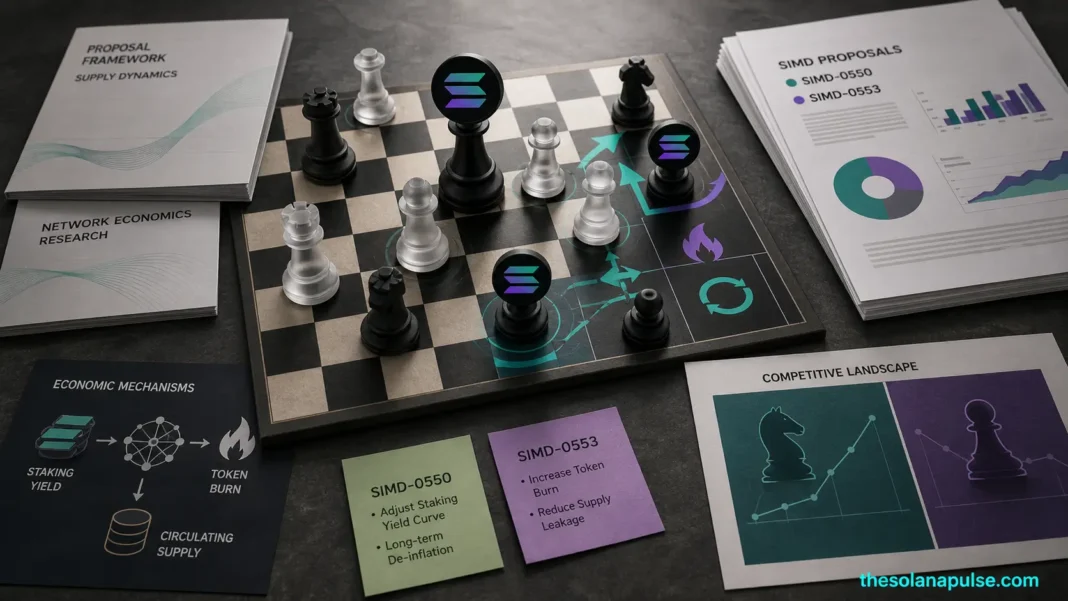
Solana’s latest proposals, SIMD-0550 and SIMD-0553, are poised to redefine its economic framework, potentially impacting its competitive stance in the crypto space. As Solana and Ethereum both consider adjustments to their token supply mechanisms, these changes could reshape the dynamics of staking yields and token burns across both networks.
The Thesis
SIMD-0550 aims to accelerate Solana’s disinflation, doubling the annual reduction rate from 15% to 30%. This would mean reaching Solana’s terminal inflation floor three years earlier than previously planned. SIMD-0553 proposes a switch to resource-based transaction fees, which could amplify daily SOL burns significantly. Galaxy Research suggests that these changes could alter Solana’s supply trajectory, reducing future emissions by approximately 18.9 million tokens.
In parallel, Ethereum’s EIP-8361 would introduce a dynamic mechanism to burn validator rewards based on the percentage of ETH staked, potentially halving validator yields from 2.6% to 1.2% if staking reaches 50% of total ETH.
The Data
Galaxy Research’s analysis highlights a pivotal moment for Solana, with these proposals marking a significant shift in its economic approach. By doubling the disinflation rate, Solana aims to reduce its circulating supply more aggressively, potentially increasing its scarcity value. The resource-based fee structure could further enhance this scarcity by significantly boosting the rate of SOL burns.
Ethereum’s approach with EIP-8361 focuses on modifying validator incentives, which could impact network security dynamics and staking behavior. Both networks are exploring ways to optimize their economic models for long-term sustainability and competitiveness.
Deep Dive Analysis
Solana’s strategic moves are reflective of a broader trend among blockchain networks seeking to refine their economic models. By addressing both inflation and transaction fee structures, these proposals could enhance Solana’s appeal to investors looking for a more deflationary asset. Additionally, the increased burn rate could improve the network’s tokenomics by creating a more attractive supply-demand balance.
Ethereum’s proposal, on the other hand, is more focused on maintaining network security while adapting to changing market conditions. The potential reduction in validator yields may affect staking incentives, leading to shifts in how validators approach network participation.
Implications & Outlook
The implications of these proposals extend beyond immediate supply dynamics. For Solana, the increased burn rate and accelerated disinflation could position it more favorably against competitors like Ethereum, particularly in the eyes of investors seeking long-term value appreciation. As these proposals move through governance, their successful implementation could signal a new era of economic strategy for layer-1 networks.
Looking ahead, the adoption and market reception of these changes will be crucial. Solana’s ability to effectively communicate the benefits of these proposals to its community and potential investors will determine their ultimate impact. Similarly, Ethereum’s focus on validator incentives highlights the ongoing evolution of economic models in response to network needs and market pressures.
Solana’s supply adjustments could set a new standard for economic strategy in blockchain networks.
Editor’s Insight
TheSolanaPulse’s original analytical take: As Solana and Ethereum both explore innovative ways to manage their supply, these proposals underscore a growing trend towards more adaptive economic models in blockchain networks. Solana’s dual proposals could enhance its competitive positioning by making it a more deflationary asset, appealing to investors focused on long-term value growth.
Forward-looking perspective on what to watch: Market reactions to these proposals will be telling. If Solana’s governance successfully implements these changes, it could redefine its market narrative, emphasizing scarcity and strategic supply management as core components of its value proposition.