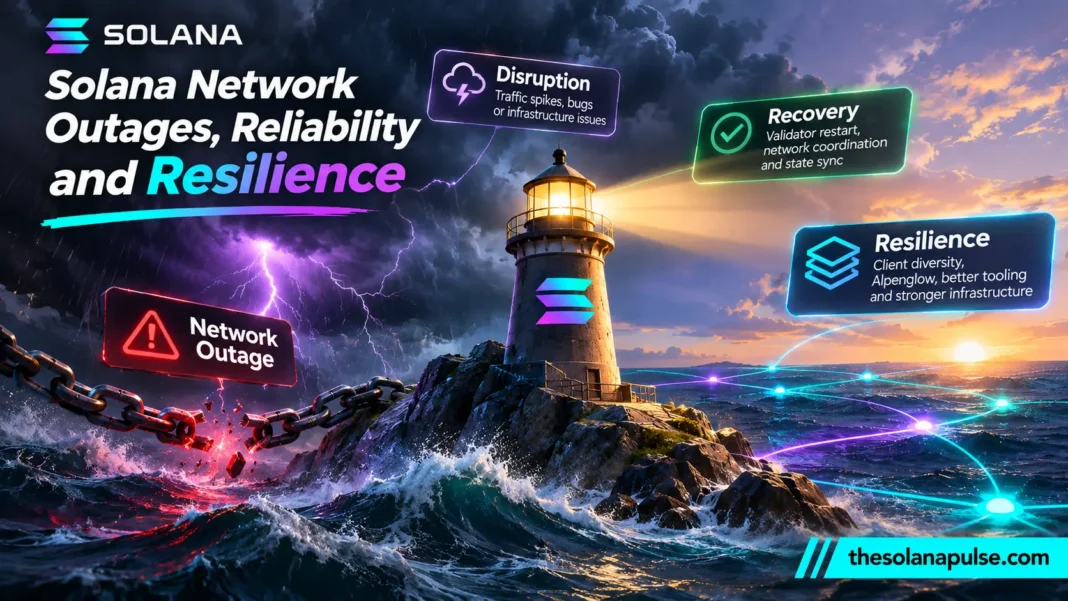
Solana network outages are periods in which normal blockchain service becomes unavailable or materially impaired. The most consequential incidents interrupt the network's ability to settle new transactions, but other disruptions can affect only particular applications, RPC endpoints or users. Understanding that distinction is essential for anyone using Solana for payments, trading, staking or business operations. A failed swap is not automatically evidence that the blockchain has stopped, and a functioning block explorer does not establish that every transaction can be executed successfully.
This guide reviews documented historical incidents, the engineering lessons that emerged from them, and practical ways to evaluate network reliability. It also explains why resilience is a property of the entire settlement workflow, not merely the speed of a consensus algorithm. The technical status snapshot was reviewed on November 26, 2026. Historical facts are dated, and illustrative calculations are not live network measurements. For the wider settlement and business context, see the Solana Institutional Hub.
- A network-wide halt is different from congestion, an RPC outage or a failed application transaction.
- Historical incidents had distinct causes, including traffic overload, block propagation problems and validator software defects.
- The August 2026 routing disruption affected substantial stake without stopping the chain.
- Alpenglow changes consensus and targets faster finality, but does not guarantee uninterrupted service.
- Uptime is meaningful only with a defined service, observation window and methodology.
- Verify transaction outcomes before retrying; resilient applications need independent observations and safe reconciliation.
- Check the official status page for the affected cluster and component.
- Save the transaction signature, time and application details.
- Compare ledger progress and transaction status using an independent trusted source.
- Distinguish successful execution, execution errors, pending or expired transactions.
- Avoid duplicate payments or unnecessary replacement signatures until the previous outcome is understood.
- Resume normal workflows only after verifying recovery and reconciling pending actions.
1. What counts as a Solana network outage?
A blockchain provides both a record of prior transactions and a mechanism for extending that record. During a severe liveness failure, users may still be able to inspect previously settled balances while new transactions cannot achieve the required settlement status. This is different from losing the entire historical ledger. It is also different from a security breach in which someone obtains control of a private key or exploits an application program. Each category creates different recovery requirements.
A network can suffer degraded service before a full halt. Blocks might continue to appear while economic transactions become difficult to land, or finalization might slow enough to make time-sensitive applications unusable. An outage definition that looks only at the existence of new blocks can therefore miss important failures. Conversely, classifying every failed transaction as downtime overstates network-level disruption. Define the specific service being measured before assigning an incident label.
For a user, the immediate question is whether a requested action has actually executed. For a business, it is whether the payment, withdrawal or settlement can meet its service commitment. For a validator, it is whether the node is participating correctly and keeping up with the cluster. Those questions overlap but are not identical. A useful reliability report describes the affected component, scope, start and recovery times, and the evidence for the classification.
2. Network halt, congestion, RPC failure and application failure
Congestion occurs when demand competes for finite execution or submission resources. Transactions may wait, expire, or fail because the conditions under which they were constructed are no longer valid. A popular program or account can experience intense competition even when unrelated parts of the blockchain remain usable. A network-wide consensus interruption instead prevents normal agreement on new ledger state across the cluster.
RPC services are intermediaries that expose blockchain information and accept requests from applications. An endpoint can run out of capacity, become temporarily unavailable, or serve older data than another endpoint. A wallet relying exclusively on that service may display an incorrect or delayed balance. Similarly, an indexer can be behind the chain even if its underlying RPC remains responsive. Neither circumstance alone proves a consensus failure.
Application failures include inaccessible websites, incorrect instructions, expired quotes, insufficient balances and unexpected program errors. These can persist after a network incident is resolved. For example, a decentralized exchange might require a fresh quote after a price change during a disruption. Retrying an old transaction without inspecting its validity can compound the problem. A good incident response distinguishes the original problem from the downstream symptoms it creates.
| Incident type | What is affected | Diagnostic evidence |
|---|---|---|
| Consensus halt | Network settlement | Finalized state fails to advance across independent sources |
| Congestion | Transaction landing or execution | Blocks advance but landing is degraded |
| RPC disruption | Provider access | Independent endpoint remains fresh |
| Indexer lag | Displayed history | Ledger data is ahead of indexed data |
| Application failure | Specific workflow | Other applications work normally |
3. Historical outage timeline: 2020 to 2024
Solana's early operating history includes several significant service interruptions. On December 4, 2020, new block confirmations stopped, as described in the Foundation's postmortem. The incident established an early example of the importance of shared-ledger recovery and coordinated operator communication. On September 14, 2021, the network experienced roughly seventeen hours of downtime. These are historical events, not statements about current network conditions.
The April 30, 2022 incident was associated with overwhelming transaction demand around NFT minting. The contemporary report discussed improving traffic handling, including adoption of QUIC for more controlled network communication. On June 1, 2022, a defect involving durable nonce transactions interrupted consensus. These cases demonstrate two distinct failure classes: capacity and traffic-management problems, and correctness defects in software handling particular transaction features.
On September 30, 2022, a fork-related implementation defect prevented normal recovery of consensus. The October 2022 network performance report describes the interruption as lasting six hours and nineteen minutes. February 2023 and February 2024 then brought two further major incidents with different underlying causes. Reading individual postmortems is more useful than treating these incidents as a single repeated failure with one universal solution.
The historical table below is a selection of documented events, not a comprehensive count of every degraded service or regional endpoint incident. Durations reflect the definitions used in the cited reports; a provider's own service may have recovered later than the blockchain itself. This matters when comparing figures across different sources.
| Date | Documented event | Approximate duration / scope |
|---|---|---|
| Dec 4, 2020 | Block confirmations halted | Historical mainnet stall |
| Sep 14, 2021 | Severe network outage | 17 hours |
| Apr 30, 2022 | Traffic overload and consensus stall | 7 hours |
| Jun 1, 2022 | Durable nonce defect | 4.5 hours |
| Sep 30, 2022 | Fork recovery defect | 6 hours 19 minutes |
| Feb 25–26, 2023 | Block propagation degradation | About 19 hours 42 minutes from degradation to recovery |
| Feb 6, 2024 | Compiled-program cache defect | About 5 hours |
December 2020 postmortem ↗ September 2021 outage overview ↗ April 2022 outage report ↗ June 2022 outage report ↗ October 2022 performance report ↗ February 2023 outage report ↗ February 2024 Anza outage report ↗
4. February 2023: block distribution and feedback loops
The February 25, 2023 outage report describes degradation of block propagation associated with an unexpectedly large block and malfunctioning forwarding services. Repeated forwarding overloaded duplicate-detection mechanisms and disrupted the distribution path. Validators fell back to slower recovery mechanisms, and timely finalization became increasingly difficult. The chain eventually required a coordinated restart to return to normal operation.
This case is useful because the root cause was not merely a large amount of ordinary customer activity. Interactions between infrastructure components amplified an abnormal condition. A system that can tolerate a large input under normal assumptions may behave differently when another service repeatedly sends that same data back into the system. Reliability testing therefore needs to include combinations of components, not just isolated benchmarks.
The report also explains the historical vote-only safety behavior that limited economic transactions while finalization was falling behind. This behavior illustrates a trade-off between continuing to accept new work and avoiding unsettled state accumulation. The postmortem reported no rollback of finalized economic transactions. That finding is specific to the documented incident and should not be interpreted as an unconditional promise about all possible future failures.
The engineering response addressed duplicate filtering and collaboration with forwarding-service operators. For present-day infrastructure reviews, the durable lesson is to map feedback paths, load amplification and external service dependencies. The precise consensus mechanism has since changed, so historical thresholds and modes should not be assumed to describe every modern release.
5. February 2024: a validator software defect
On February 6, 2024, Solana stopped finalizing blocks. Anza's outage analysis attributed the incident to a defect related to the handling of cached compiled programs, involving older program-loader behavior. A fix was prepared, validator operators coordinated a common recovery point and compatible software release, and normal consensus progress returned around five hours after the incident began.
The significance of this event is that an uncommon execution path can affect otherwise healthy infrastructure. Adding more bandwidth or faster processors would not automatically resolve a defect that causes software to stop making progress. Correctness testing, regression coverage, release discipline and recovery procedures are essential complements to performance engineering. A network can be fast under representative workloads but still have a previously undiscovered failure mode.
The report describes the actual recovery and root cause rather than simply attributing the event to high traffic. When reviewing future incidents, wait for a documented technical explanation before repeating a preliminary diagnosis. Social media posts during an outage frequently reflect symptoms, hypotheses or partial information. A responsible incident history separates the observation that service was impaired from the later determination of why it happened.
February 2024 Anza outage report ↗
6. The 2026 reliability picture and the August routing incident
Solana's June 2025 health report described sixteen months of continuous network uptime at the time of publication. The Foundation's research page subsequently reported uninterrupted network uptime since February 2024 in its September 2026 reporting. These are dated statements about the network, not independent proof that every application or RPC endpoint remained available throughout that period.
On August 12, 2026, a routing problem at an infrastructure provider affected validators hosted in Frankfurt. The Foundation reported that nearly 29% of voting stake was taken offline by the incident, yet the network continued operating. This was a serious shared-infrastructure disruption, but it should not be added to a list of full mainnet halts simply because many validators were affected. It is evidence both of resilience in that particular event and of the potential scale of geographic or provider concentration.
The event occurred before Alpenglow's mainnet activation. Its outcome cannot establish that the same percentage of offline stake would be tolerated under every later consensus design or every network partition. Fault assumptions, voting participation, timing and the nature of the unavailable nodes matter. An incident that the network survives under one combination of conditions does not establish an unlimited safety margin.
At the November 26, 2026 research check, the official status page listed the mainnet cluster and its listed RPC and explorer components as operational. This is a snapshot of reported service status, not a promise about future uptime or a measurement of every third-party provider. Readers checking a current issue should consult the live page rather than rely on this dated statement.
| Observation | Classification | Interpretation |
|---|---|---|
| June 2025 health report | Dated network report | 16 months of continuous uptime reported |
| August 12, 2026 | Shared hosting/network incident | Nearly 29% of stake offline; chain continued |
| September 2026 research report | Dated network report | Continuous uptime since February 2024 reported |
| November 26, 2026 | Status snapshot | Mainnet listed as operational |
Official Solana status ↗ June 2025 network health report ↗ Solana research ↗ August 2026 routing incident ↗ Foundation reliability discussion ↗
7. How Alpenglow changes the reliability discussion
Alpenglow became active on mainnet on October 21, 2026. According to the Foundation's upgrade documentation, it replaces TowerBFT consensus with a certificate-based design in which validators exchange votes directly. Its target finality is around 150 milliseconds, rather than the much longer finality associated with the prior design. The upgrade also describes separate tolerance assumptions for malicious and unavailable stake.
A target is not the same as a guaranteed checkout time. A transaction may spend time reaching a leader, waiting for execution resources or being observed by the application's data provider before the consensus finality measurement becomes relevant. A user who measures the interval from tapping a button to receiving a receipt is measuring a larger system. Report these metrics separately to avoid attributing client-side or RPC delays to consensus alone.
The documented fault model is also not a universal availability warranty. It describes protocol assumptions, rather than a guarantee that any possible combination of software defects, network partitions or operator failures will be harmless. Reliability analysis after a consensus upgrade should review current documentation and observed performance, not simply reuse thresholds from older incident reports. Consensus evolution reduces some risks while introducing new software paths that require testing and operational experience.
8. Why client diversity and hosting diversity both matter
Independent client implementations can help reduce the chance that a defect in one codebase disables every participating node. Agave and Firedancer are important examples of independent implementations in Solana's ecosystem. However, independence of code does not guarantee independence of operations. Different validators may still share a hosting company, network transit provider, monitoring service or block distribution dependency.
A useful risk assessment therefore maps at least three dimensions: software lineage, voting stake, and infrastructure dependencies. A count of validator names is insufficient when the same operator controls several identities or when one software family accounts for much more stake than another. Similarly, geographic diversity does not necessarily eliminate shared-provider exposure if a common control plane or routing system connects those locations.
Consider a hypothetical operator fleet spread across three facilities. If all facilities use one upstream network provider, a fault in that provider could interrupt the entire fleet. Conversely, two independent network providers located in one building may still share the same power supply. Genuine resilience is achieved by identifying realistic shared failure domains and testing recovery from their loss. For background on validator responsibilities, see What Is a Solana Validator?.
9. How to measure uptime without misleading comparisons
Uptime usually describes the fraction of a defined observation period during which a defined service was available. A simple time-based calculation subtracts unavailable minutes from total monitored minutes and divides the result by the total. The result depends on the service definition and measurement window. Thirty minutes of downtime affects a one-day percentage much more than an annual percentage.
An illustrative thirty-day month has 43,200 minutes. If settlement is unavailable for thirty minutes and no other downtime occurs, availability is approximately 99.9306%. A separate RPC provider with 120 minutes of unavailable service would have approximately 99.7222% availability under the same measurement window. These figures are hypothetical and do not describe measured Solana performance. They demonstrate why the two figures should never be substituted for each other.
A time-based percentage also treats every minute equally. An interruption during a busy commercial period may have much greater operational impact than the same interruption at a quiet time. Transaction success rate, confirmation latency and user-visible availability complement the uptime calculation. A service can achieve a very high uptime number while still disappointing users during periods of peak demand.
Define the measurement boundaries in any report: whether partial outages count, how missing observations are treated, how overlapping incidents are combined and whether the period includes planned maintenance. If two failures occur simultaneously, their durations must not be double counted in a single availability calculation. Report the number of observed incidents, total unavailable time and service definition alongside the percentage.
| Hypothetical 30-day measure | Unavailable minutes | Availability |
|---|---|---|
| Settlement | 30 | 99.9306% |
| RPC provider | 120 | 99.7222% |
| Application | 60 | 99.8611% |
10. Reliability metrics that matter to applications
A settlement application needs more than a status indicator. It should track submission outcomes, the fraction of intended transactions that actually land, successful execution, and time to the required commitment. An RPC acceptance response indicates that a submission was accepted by the service, not necessarily that the blockchain executed it. Failed on-chain execution must also be distinguished from a transaction that never landed.
Useful latency statistics include the median and upper percentiles. The median describes a typical observation, whereas the 95th or 99th percentile reveals slower outcomes that can create business problems. Measure from a clearly defined starting point, such as signed submission, and identify whether the ending point is observed execution or finalized settlement. If the application excludes timeouts from its sample, it should report them separately instead of making the remaining latency statistics appear artificially favorable.
Operational dashboards should also measure endpoint freshness and error rates. Comparing block or slot progression across independently operated providers helps detect whether one provider has fallen behind. An explorer is a useful supplementary view, but a delayed indexer must not be treated as the ultimate source of settlement truth. Use the RPC methods appropriate to the required confirmation semantics and application workflow.
| Metric | What it measures | Reporting caution |
|---|---|---|
| Finalized progression | Consensus liveness | Compare independent observations |
| Landing rate | Submitted transactions included | Separate expiration and unknown status |
| Execution success | Landed transactions without execution error | Do not include failed execution as success |
| P95 latency | Slow end of observed settlement | Report timeouts separately |
| RPC freshness | Endpoint state lag | Measure against healthy independent endpoints |
Confirmation and finality ↗ sendTransaction RPC ↗
11. How network recovery works
A severe consensus incident requires developers and operators to determine the nature of the failure and establish a safe way forward. Historical Solana restarts involved identifying compatible software and a shared ledger recovery point. Operators prepared the necessary state and coordinated the restart. Such procedures depend on the protocol and the particular incident; they are not a generic instruction to reboot every validator whenever an endpoint fails.
Recovery is not complete simply because a new block appears. Operators need evidence that consensus progresses normally, nodes synchronize, and the network can sustain ordinary economic activity. Applications may then need to rebuild expired requests, refresh data and reconcile pending operations. Some providers can remain impaired even after the base network has resumed. Record both network recovery and downstream service restoration.
A well-managed postmortem documents observed symptoms, the root cause when established, contributing conditions, mitigation, and preventive actions. It also records unresolved questions. The goal is to reduce the chance of recurrence and improve response, not to promise that an entire category of faults can never recur. An announced patch should be distinguished from a deployed and tested mitigation.
From network interruption to recovery
Identify abnormal settlement progression.
Establish the failure and safe mitigation.
Coordinate compatible restoration and verify progress.
Resolve pending application operations.
Conceptual incident recovery; actual restart procedures are incident-specific.
12. What to do when your Solana transaction appears stuck
Start by retaining the transaction signature, if one was created, and the time and application associated with the request. Check the official status page and compare the transaction through an independent explorer or trusted RPC. If no signature exists, the issue may have occurred before submission. If a signature exists but is not found, it may still be pending, unknown to the chosen endpoint or expired. Absence from one explorer is not proof of failure.
Check the actual execution result rather than relying only on a wallet's spinner. A transaction may be recorded with an execution error; that differs from a successfully completed transfer. Recent-blockhash transactions also have a validity boundary. Follow the current confirmation and expiration guidance and establish whether the previous transaction can still execute before building a replacement. Durable nonce transactions have different validity behavior and should be handled accordingly.
Do not share a recovery phrase or private key with anyone claiming to fix an outage. Legitimate network recovery does not require an ordinary user to enter a seed phrase into a support website. If a support request asks for unnecessary wallet permissions, stop and verify the official support channel. Our How to Use Solscan guide explains how to inspect recorded transactions, and Solana Transaction Fees Explained covers the cost of submitted transactions.
Diagnose a stuck transaction
Keep the signature and submission time.
Check status and independent data sources.
Inspect execution and validity.
Reconcile the result before replacing the request.
Never assume that a missing explorer record means a payment failed.
Confirmation and finality ↗ Transaction confirmation and expiration ↗ sendTransaction RPC ↗ Retrying transactions ↗
13. Designing resilient payments and business workflows
A merchant should maintain an order record independent of the wallet interface. The record should identify the expected payment asset, amount, recipient, unique reference and the transaction signatures associated with the order. Mark an order complete only after verifying successful execution and the business's required settlement status. A network incident is not a reason to bypass those checks.
Suppose a customer submits a 50 USDC payment just before an endpoint stops responding. The merchant cannot immediately determine whether the transaction landed. The appropriate workflow is to place the order in a pending reconciliation state, check a healthy data source when possible, and avoid prompting the customer to pay twice merely because the first endpoint timed out. If a duplicate payment occurs, it should be recognized and handled under the merchant's refund policy.
Idempotent fulfillment means the same verified payment cannot trigger delivery repeatedly. A database constraint or equivalent durable record can enforce this even when payment notifications arrive more than once. Store the verification result, and make repeated callbacks safe. For payment request and reconciliation mechanics, see Solana Pay. These controls are valuable during normal operations as well as major incidents.
14. DeFi exposure during periods of impaired access
DeFi applications often depend on price feeds, trading liquidity and the ability to execute protective transactions promptly. During degraded service, users may not be able to rebalance collateral, repay debt or close a position at their preferred time. Market prices can continue changing elsewhere even if access to a particular on-chain venue is impaired. The result can be a significant difference between the price expected before an incident and the price available when service returns.
A network halt does not necessarily mean every financial obligation is canceled or that liquidation risk disappears permanently. Protocol-specific behavior determines how prices, debt and settlement are handled. When service resumes, positions may be evaluated using updated information. Users should understand the actual rules of the protocol before assuming an outage pauses every risk. Avoid making a protection strategy dependent on a last-second transaction.
Risk management therefore includes conservative exposure, liquidity planning and awareness of shared dependencies. A user who holds several positions tied to the same collateral asset or oracle has correlated exposure even if the positions use different applications. Keep an independent record of obligations and do not assume that a high uptime figure eliminates the possibility of a financially meaningful interruption. The Solana DeFi Risk Management guide provides a broader framework for these decisions.
15. A practical incident-response and continuity plan
Every application should define what normal operation looks like and the conditions that trigger degraded mode. For example, a payment business might suspend automatic fulfillment when independent verification is unavailable, while allowing customers to view previously settled orders. The decision should be tied to measurable evidence and documented business requirements rather than a single social media report.
Assign ownership for the decision to pause submissions, communicate with users and resume operations. Maintain independent service endpoints and test their failover under realistic conditions. Record transaction identifiers before sending requests, preserve logs and ensure that reconciliation can recover work interrupted by a process restart. Store only necessary operational data and keep secret signing material outside diagnostic logs.
During recovery, review unresolved transactions before retrying. Refresh quotes and time-sensitive business conditions. Reconcile actual balances with internal accounting, check whether notifications were delivered, and confirm that fulfillment or payout actions occurred only once. Clear the incident queue gradually rather than assuming every previous request must be repeated. This protects against duplicate economic actions and unnecessary service costs.
After the event, review what failed, what worked, and how long each component took to recover. Update the monitoring rules and test the revised workflow. A continuity plan is most valuable when exercised before an incident, since access to operators, documentation and monitoring may itself be impaired during a real disruption.
| Continuity stage | Control | Evidence |
|---|---|---|
| Preparation | Test independent providers | Failover logs |
| Detection | Measure settlement and freshness | Alert with timestamp |
| Containment | Pause unsafe fulfillment | Pending order records |
| Recovery | Reconcile unresolved operations | Verified signatures and balances |
| Review | Document mitigation and retest | Incident report |
Frequently asked questions
Is Solana down right now?
Check the live official status page and independently observe settlement. A dated article cannot establish current status.
When was the last major outage?
The reviewed Foundation history identifies February 6, 2024 as the most recent major network halt in its dated uptime discussion.
Does a failed swap mean Solana is down?
No. It may be an application error, expired request, slippage condition or congestion.
Can an RPC go down while Solana works?
Yes. RPC availability and consensus liveness are distinct.
What is a network restart?
A coordinated recovery procedure for a severe network incident, using a compatible recovery plan.
Did Alpenglow eliminate outages?
No. Its consensus design changes finality and fault assumptions but cannot eliminate all failures.
Does a halt mean my funds are gone?
Not by itself. Verify settled ownership and any pending transactions after recovery.
Should I immediately resend a stuck payment?
No. First establish whether the original transaction executed or can still execute.
Why can a block explorer be behind?
Its indexing service may lag the chain or its RPC source.
Does 100% reported uptime guarantee future reliability?
No. It describes a specific past measurement and service definition.
Can downtime affect DeFi positions?
Yes. Access disruptions can prevent timely protective actions while external prices change.
What is the best reliability metric?
Use several: settlement availability, transaction landing and success, confirmation latency and endpoint freshness.
Final thoughts
Solana’s outage history illustrates the importance of correctness, independent implementations, network connectivity and coordinated recovery. Its subsequent operating record and consensus evolution provide evidence of progress, not proof that interruption is impossible. Measure the service you actually depend on, keep evidence of unresolved transactions and design workflows that can recover safely when normal access is impaired.
Sources and further reading
- Official Solana status ↗
- December 2020 postmortem ↗
- September 2021 outage overview ↗
- April 2022 outage report ↗
- June 2022 outage report ↗
- October 2022 performance report ↗
- February 2023 outage report ↗
- February 2024 Anza outage report ↗
- June 2025 network health report ↗
- Solana research ↗
- August 2026 routing incident ↗
- Foundation reliability discussion ↗
- Alpenglow upgrade ↗
- Confirmation and finality ↗
- Transaction confirmation and expiration ↗
- sendTransaction RPC ↗
- Retrying transactions ↗