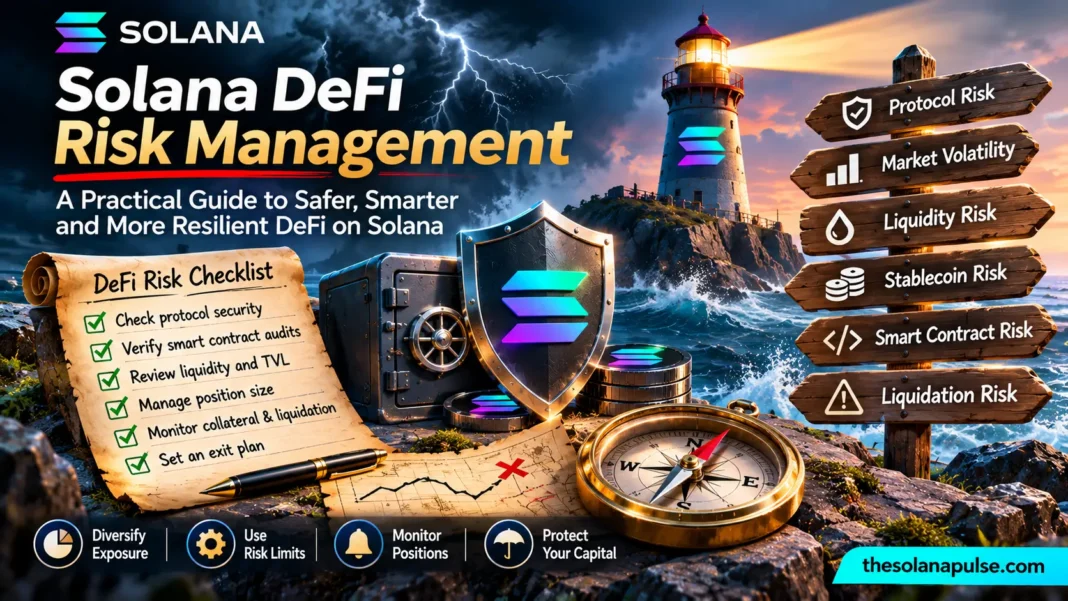
Solana DeFi risk management is the process of identifying what can go wrong in a decentralized finance position, estimating the consequences, limiting exposure and preparing a response before capital is committed. A fast blockchain and a convenient wallet interface do not eliminate the financial, operational or technical hazards of lending, swapping, supplying liquidity or holding receipt tokens. The relevant question is not simply whether a protocol works today, but whether a position remains manageable when prices move, liquidity disappears or a dependency fails.
This guide provides a framework for reviewing individual positions and their combined exposure. It complements the Solana DeFi Hub rather than repeating the mechanics of every DeFi product. Readers will learn how to create a risk register, examine contracts and token authorities, stress-test collateral, set exposure limits and build a realistic exit plan.
Research reviewed 25 November 2026. All numerical examples are hypothetical educational illustrations, not live rates, forecasts, personalized investment recommendations or assurances of safety. Crypto losses can be substantial or total. Product parameters and availability can change.
- Identify underlying assets, contracts, authorities and shared dependencies, not only the application name.
- An audit, high TVL or established brand does not guarantee safety or immediate withdrawals.
- Measure leverage, liquidation buffers, stablecoin exposure and liquidity under adverse conditions.
- Diversification across interfaces is not genuine diversification when they use the same collateral or market.
- Keep a written risk budget, review triggers and an exit plan.
- Separate wallet incidents from protocol failures and market losses.
- Identify the exact protocol, market, token mints and underlying assets.
- Read the risk documentation, audit scope, authority and withdrawal conditions.
- Calculate tolerable loss and test price and liquidity shocks.
- Check overlap with existing positions, including shared stablecoins and vaults.
- Verify wallet requests, retain a separate SOL fee reserve and document the intended exit.
- Use read-only monitoring and review triggers; avoid positions whose failure consequences are unclear.
1. Build a risk map before choosing a strategy
A risk map begins with a distinction between a product and a position. A lending application can offer several markets with different collateral, liquidity and governance arrangements. A liquidity venue can support both mature token pairs and newly created pools with little history. Saying that capital is deployed in a well-known protocol gives little information about the specific loss mechanisms of the selected market.
Write down the asset deposited, the claim received, the parties or programs controlling that claim, and the conditions under which it can be converted back. For a simple liquidity position, the claim may represent a share of two reserves. For a managed vault, there may be another layer between the depositor and the underlying pool. For a lending position with debt, recovery depends on both available market liquidity and the obligation attached to the collateral.
Distinguish market loss from failures in access or settlement. A token price decline may reduce economic value even though every contract operates correctly. An exploit can cause a loss without any broad market decline. A withdrawal restriction can prevent timely access while the accounting value remains unchanged. These outcomes require different monitoring signals and different mitigation decisions.
Record uncertainty as a risk in its own right. If a protocol does not explain its upgrade process, if a receipt token has an unclear redemption method, or if a displayed rate cannot be reconciled with economic activity, the absence of information is not evidence of safety. A decision to wait or avoid an exposure is a valid risk-management outcome.
| Risk family | Example failure | Useful control |
|---|---|---|
| Market | SOL or reward token price drops | Stress test and exposure limit |
| Credit | Liquidation leaves bad debt | Review isolation and loss rules |
| Liquidity | Thin exit market | Check executable exits |
| Technical | Faulty program upgrade | Review deployed version |
| Operational | Malicious signature | Separate wallets |
| Dependency | Shared oracle fails | Map common exposure |
2. Set a loss budget rather than chase advertised returns
A loss budget expresses how much capital could be lost without making essential expenses, emergency savings or other obligations dependent on a successful DeFi outcome. It differs from a target yield. An attractive annualized return does not change the amount that can be lost in a contract failure. The budget should therefore be evaluated before comparing rates.
Assign each position a severe loss scenario and a separate catastrophic scenario. A volatile token might be tested against a substantial price decline, while a smart contract exposure should also be evaluated against the possibility of losing all recoverable capital. Severe scenarios are planning tools, not predictions, and they must not be interpreted as a floor below which losses cannot go.
Consider a fictional portfolio with $10,000 allocated to experimental digital asset strategies. Its owner considers a $1,000 position in a new vault. If the vault suffered a total loss, the direct impact on this portfolio would be 10%. This calculation does not include spillover into other positions using the same assets. If the owner cannot accept that outcome, a smaller exposure or no exposure is more consistent with the stated budget than a higher return target.
Position sizing should also reflect the ability to monitor a strategy. A concentrated liquidity position or a leveraged loan may require intervention while a passive holding does not. Holding multiple positions that need simultaneous action during a rapid market decline can exceed the user’s operational capacity, even when each is individually small.
3. Evaluate smart contracts and governance controls
On Solana, applications use executable programs and accounts that maintain state. A user may interact with a familiar front end while the transaction actually calls several programs. Inspecting the official program addresses is therefore more useful than relying on a recognizable logo or a link shared in a social channel.
An audit is evidence that a defined implementation was reviewed under specified assumptions. It is not an insurance policy. Check the date, the code version, the components covered, the severity of unresolved findings and whether fixes were subsequently reviewed. A report covering a core lending contract may not cover a new vault adapter, a newly supported collateral asset or the user interface. An audit logo without a report and scope provides little evidence.
Review who can upgrade the program or change its configuration. Solana permits upgradeable programs to have an upgrade authority. Where an authority remains, the code may be changed under applicable loader rules. A multisignature authority can reduce reliance on one key, but its security also depends on signer independence, key custody and the threshold. A timelock may offer time to respond to changes, if it is actually enforced and the relevant operation is covered.
An immutable program is not automatically preferable: it may prevent a quick repair of a serious bug. A verified build helps connect deployed code to a particular source version but says nothing by itself about the economic soundness of that code. Examine both the technical design and the ability to respond to faults.
Program deployment Verified builds
| Evidence | Question to ask | What it cannot prove |
|---|---|---|
| Audit | Does the scope cover the deployed product? | No unknown bugs exist |
| Verified build | Does deployed code match source? | Source is secure |
| Authority | Who can change the program? | Future upgrades are safe |
| Timelock or multisig | Which actions and signers are covered? | Keys cannot be compromised |
4. Understand token-specific risk and stablecoin exposure
An asset ticker is not a reliable identity. On Solana, the mint address distinguishes one token from another. A token with the same symbol, image and name as a familiar stablecoin can have a completely different issuer and transfer rules. Confirm the mint using issuer or project documentation rather than copying an address from an unsolicited message.
Review the token program and relevant authorities. A freeze authority can prevent transfers from affected token accounts. Some Token-2022 extensions impose transfer fees or other conditions that change the expected behavior of a transfer. A protocol accepting an asset does not mean every possible feature of that asset is supported by all exit routes.
Stablecoins introduce risks separate from SOL volatility. A fiat-backed token depends on the issuer, reserve arrangements, redemption eligibility and payment infrastructure. A synthetic dollar may depend on collateral and hedging counterparties. A bridged representation additionally depends on the cross-chain mechanism and custody or verification model. Stable pricing under normal conditions cannot establish that these risks are absent.
For a portfolio containing several stablecoin strategies, group exposures by the underlying issuer and asset. A lending deposit in USDC, a USDC-heavy pool and a vault backed by USDC can all be affected by the same redemption disruption. Diversification across protocols will not prevent that common shock. Check whether the instrument is a direct token, a vault share or an additional receipt claim, because each adds different constraints on recovery.
Token freeze authority Token transfer fees Circle reserve transparency USDC terms
5. Look through vaults and receipt tokens to underlying exposure
Composability makes it possible to use a token representing one DeFi position as an input to another. A liquid staking token can serve as collateral, a lending receipt can be managed by a vault and a pool share can be deposited into a farming strategy. These products may simplify the workflow but they do not remove the dependencies underneath it.
Consider a vault whose underlying position is a SOL-backed liquid staking token deposited in a lending market. Its recoverable value may depend on the staking pool’s conversion rate, liquidity for the token, lending market solvency, the vault’s allocation rules and the ability to redeem the vault share. If the vault is leveraged, debt adds another path to loss. The number of tokens shown in a wallet does not reveal this chain.
Make a dependency list with one row for every layer. Include the program, asset mint, oracle where relevant, and the exit mechanism. If two vaults both allocate to the same lending reserve, label that reserve once as a shared dependency. This prevents apparent diversification from obscuring concentrated exposure.
Avoid double counting capital. A receipt token is generally a claim on assets rather than an additional independent asset. If a $500 vault share represents $500 of underlying assets, adding both amounts falsely reports $1,000. If the strategy is leveraged, distinguish gross exposure from net equity.
A generic layered exposure example.
Receipt token or vault share.
Allocation, rebalancing and fees.
Lending reserve, LP or staking pool.
Assets, oracles, operators and exit liquidity.
A failure in a lower layer can affect every claim built above it.
6. Measure liquidation risk with adverse scenarios
A collateralized loan has at least two different limits: the maximum permitted borrowing level and the point at which the protocol can begin liquidation. A user who borrows near the maximum may have little room for collateral price changes, interest accrual or changes in risk parameters. Different protocols may apply weights to collateral and debt rather than a single simple ratio.
For an educational single-collateral example, assume 10 SOL initially valued at $100 each, a debt of $400 and a hypothetical liquidation threshold of 75%. The initial loan-to-value ratio is 40%. If debt is unchanged, the threshold is reached when collateral value falls to about $533.33, or $53.33 per SOL. This is a theoretical trigger and not a guaranteed execution price. If debt grows to $420, the corresponding price becomes $56. The position becomes more vulnerable without additional borrowing.
Stress testing is more useful than checking a green indicator at the moment of deposit. Test a sudden price drop, a gradual rise in debt and a simultaneous decline in available exit liquidity. Consider whether the debt asset can rise in value relative to the collateral. A loan denominated in a volatile asset can become riskier even if the collateral price is unchanged. For a multi-asset account, use the actual health calculation provided by the protocol.
The protocol may liquidate part of a position, charge a liquidation incentive or change permitted actions on an unhealthy account. A plan to add collateral only when the threshold is reached depends on reliable access and enough time to transact. Determine what risk level would justify reviewing or reducing the position well before a threshold is crossed.
| SOL price | Collateral value | Debt | LTV | Threshold status |
|---|---|---|---|---|
| $100 | $1,000 | $400 | 40.00% | Below |
| $80 | $800 | $400 | 50.00% | Below |
| $60 | $600 | $400 | 66.67% | Below |
| $55 | $550 | $420 | 76.36% | Above |
| $50 | $500 | $400 | 80.00% | Above |
The table uses unweighted values. Actual thresholds, oracle rules, interest and liquidation fees may differ. Kamino governance materials and risk reports illustrate why market-level controls and stress testing need examination rather than assuming a common threshold.
Kamino lending architecture Kamino September 2026 risk insights
7. Assess liquidity using recoverable value not dashboard balances
Total value locked is an accounting measure of assets associated with a protocol. It does not measure how much a particular user can withdraw at a particular time or how much a token sale will produce. A large lending market may have high utilization and little unborrowed supply. A large liquidity pool may concentrate most usable liquidity away from the current price. An apparent token price can represent a small trade rather than a realistic exit for a large position.
Estimate an exit using the quantity you actually hold and an executable quote, not simply the quoted spot price multiplied by the number of tokens. Account for pool fees, protocol withdrawal charges, price impact and network costs without counting the same charge twice. If a token is redeemable through a protocol, compare redemption conditions with a market sale. The cheaper route in normal markets might be unavailable when many users exit together.
An exit plan should cover debt obligations attached to a position. A lending receipt may not be fully withdrawable until the debt is repaid, and a leveraged position might require an unwind before assets can be transferred. Do not assume the application will permit every withdrawal displayed in its portfolio valuation. Review caps, queues, cooldowns, account health restrictions and the consequences of pausing a market.
Keep an accessible reserve separate from risky positions. A reserve depending on the same protocol or token as the obligation it is meant to support may fail at the same time. A small SOL balance for fees is operationally useful, but it cannot compensate for missing market liquidity or a protocol pause.
8. Control liquidity provider and yield strategy risks
Liquidity provision changes a position’s composition as traders exchange assets. The resulting inventory may be worth less than simply holding the original assets, even if trading fees are positive. Concentrated liquidity adds a specific range of activity, so a position may stop earning new trading fees when it moves outside that range. Monitoring the headline APR ignores both inventory changes and the time liquidity is active.
For a simple full-range constant-product pool, a doubling in the relative price of one asset produces a theoretical divergence loss of about 5.72% compared with holding the original quantities, before fees. The formula is not a universal prediction for concentrated or bin-based positions. A range-specific position may convert entirely into one asset at or beyond a boundary, and a managed strategy may incur costs when rebalancing.
Create a benchmark at entry and retain actual token quantities, not just a dollar amount. When reviewing the position, compare recoverable inventory plus uncounted collected fees and incentives against the value of the original quantities at the same valuation time. Subtract management and execution costs that have not already been included. This separates market gains from the contribution of the strategy itself.
Reward tokens add another exposure. A farm’s advertised yield can decline when emissions end, the reward token price falls or more capital shares the distribution. Treat incentive income as uncertain until it can be realized at a feasible price. A points program or potential future airdrop should not be booked as guaranteed proceeds. If a strategy is profitable only under a favorable assumption about a future token, record that dependency explicitly.
9. Manage oracle execution and network dependencies
A price oracle supplies reference information to programs that cannot directly observe every external market. A lending risk engine can use that information to value collateral, and derivatives can use it to determine account equity or liquidation eligibility. Oracle prices may differ from the price at which a user can immediately trade a particular amount.
Review the documented price feed, update conditions, stale-price checks and response to unusually uncertain data. Pyth’s published guidance describes the importance of considering data freshness and confidence intervals when building market risk controls. A feed that has not updated is not necessarily usable simply because its last displayed value looks plausible. In extreme circumstances, a protocol may pause activity or apply conservative valuation rules.
Execution introduces another dependency: a transaction must be submitted, processed and confirmed. A wallet preview or successful simulation does not prove that the transaction subsequently settled. When a recent blockhash expires or a transaction fails, determine the status before authorizing a replacement that could create another economic action. On Solana, fees can be incurred for transactions that execute and fail; an expired transaction that never lands is a different case.
A slow interface may be caused by a front-end problem or an RPC service issue rather than a failure of the entire network. Use trusted independent read-only sources to distinguish these cases. Avoid changing to an unfamiliar application or signing unexpected recovery instructions merely because a preferred interface is temporarily unavailable.
Pyth best practices Solana confirmation and expiration Solana fees
10. Create a portfolio exposure register
A position register should record not only capital allocated but also where loss originates. Use one valuation currency and a consistent time for all balances. For a debt-financed position, record collateral, debt, net equity and gross asset exposure separately. For a receipt token, include underlying exposure once, then attach the protocol and dependency labels without adding them to the total a second time.
The following fictional register illustrates a portfolio of $10,000 without debt. The stablecoin lending deposit and managed vault appear under different applications but share exposure to the same stablecoin issuer. The LP and direct SOL holding both have SOL price sensitivity, although the LP’s inventory changes dynamically. The reserve remains outside the listed DeFi contracts. The numbers are not a recommended allocation.
Look at combined exposure by risk driver rather than simply ranking positions by size. The $2,000 lending deposit and $1,500 vault can create $3,500 of exposure to a common underlying stablecoin if the vault is entirely invested in that token. The reserve may create another shared issuer exposure if it holds the same stablecoin. In that case nominal separation from the vault does not create protection from an issuer-specific event.
For each position, add a review date, intended time horizon and observable trigger that would prompt reassessment. Examples include a material change in collateral rules, a significant deterioration in exit quotes or a newly announced contract upgrade. A review trigger is not an automated trade instruction; the appropriate action depends on the cause, available liquidity and circumstances.
| Position | Initial equity | Underlying driver | Shared dependency |
|---|---|---|---|
| Direct SOL | $2,500 | SOL price | Solana network |
| Stablecoin lending | $2,000 | Issuer and market credit | Stablecoin A |
| Managed vault | $1,500 | Vault and underlying market | Stablecoin A |
| SOL/stablecoin LP | $2,000 | Relative prices and fees | SOL and Stablecoin A |
| Separate reserve | $2,000 | Reserve asset and custody | Depends on reserve choice |
| Total | $10,000 | Illustrative portfolio | No debt assumed |
11. Run a portfolio stress test before committing capital
A useful stress test asks how a combination of adverse events changes recoverable equity. Test each scenario separately before combining shocks, so the source of loss remains clear. Use conservative assumptions when precise values are unavailable and label those assumptions. The purpose is not to predict the probability of an event but to discover which exposures could become intolerable together.
Suppose the $2,500 direct SOL position declines by 40%, producing a $1,000 loss. The $2,000 LP position is separately assumed to lose 25% of recoverable dollar value after inventory changes and estimated exit costs, a $500 loss. A 5% stablecoin decline is applied to the $2,000 lending deposit and $1,500 managed vault, producing $100 and $75 losses. To avoid double counting, the LP estimate already includes its stablecoin exposure, and the separate reserve is assumed unchanged for this scenario.
The total modeled loss is $1,675, leaving $8,325, or a 16.75% portfolio drawdown. In another scenario, a vulnerability causes the entire $1,500 managed vault claim to become unrecoverable while other positions remain unchanged. This isolated event produces a 15% portfolio loss. A real exploit could affect shared markets and make the outcome worse. The scenario is illustrative and does not represent a measured probability or maximum possible loss.
A scenario exceeding the chosen loss budget indicates that exposure, collateral or liquidity assumptions should be reconsidered. Do not solve the problem by raising the expected return. Reducing overlap, choosing a simpler product, avoiding leverage or declining the exposure altogether are potential responses. Consider the time required to unwind positions, since multiple exits during the same shock may compete for liquidity.
| Scenario component | Starting value | Assumed loss | Loss amount |
|---|---|---|---|
| Direct SOL | $2,500 | 40% | $1,000 |
| Stablecoin lending | $2,000 | 5% | $100 |
| Managed vault | $1,500 | 5% | $75 |
| LP position | $2,000 | 25% | $500 |
| Separate reserve | $2,000 | 0% | $0 |
| Combined | $10,000 | 16.75% | $1,675 |
12. Verify wallet actions and limit authorization exposure
A secure portfolio can still be lost through a malicious signature. Use trusted links obtained from official sources and verify the requested action in the wallet. A transaction described as a simple deposit should not unexpectedly request ownership changes or permissions that cannot be explained. If the transaction preview is unclear, do not sign simply because the application is familiar.
Separating a long-term holding wallet from a working DeFi wallet can limit the amount directly accessible to a compromised interaction. This does not remove risk from assets already committed to programs. Hardware signing can protect private key material under appropriate conditions, but it does not make a malicious transaction safe if the user authorizes it. A device prompt is a final review opportunity, not proof of the application’s intent.
Distinguish a connected application from an on-chain delegate permission. Disconnecting a website can remove its session access without removing a previously approved token permission. Phantom’s documentation explains this distinction and describes reviewing and revoking token approvals. Only use trusted tools to inspect permissions and verify any revocation transaction before signing.
A recovery phrase or private key that has been disclosed must be treated differently from a suspicious delegate permission. Revoking one approval cannot restore confidentiality to an exposed key. Use the dedicated Solana Wallet Security and What to Do If Your Solana Wallet Is Compromised guides for detailed precautions. Never provide a secret phrase to a support account, risk-monitoring service or supposed recovery specialist.
Phantom connecting to apps Phantom revoking approvals Phantom wallet incident response
13. Define monitoring rules and escalation triggers
Risk monitoring works best when it measures specific positions and dependencies rather than tracking headlines alone. Start with a read-only view of wallet balances and protocol positions. Where possible, record public addresses, market identifiers and transaction signatures. A monitoring service does not need custody of assets or a private key to observe public blockchain information.
Establish a review schedule appropriate to the strategy. A leveraged position can require far more frequent monitoring than an unleveraged holding. A farm reward program may need review around its scheduled end date, while a vault needs attention when allocations, fee rules or withdrawal conditions change. A regular review is not enough on its own if a position can become unhealthy within minutes.
For an alert, specify a condition and a subsequent decision rather than a vague warning. A borrower might review a position when the health buffer falls materially below its original value. A liquidity provider might review when price leaves the chosen range or when an executable exit deviates significantly from displayed value. A contract upgrade announcement should prompt checking which programs and assets are affected.
Avoid granting new wallet permissions to notification tools when a read-only setup will suffice. Verify unusual alerts independently before acting; a fraudulent notice can imitate a legitimate risk warning. The guide to How to Track a Solana Wallet explains monitoring, and How to Use Solscan provides a reference for reconciling transaction records.
| Review signal | What to inspect | Possible response |
|---|---|---|
| Contract change | Official announcement and program authority | Reassess scope and exposure |
| Collateral health weakens | Debt, prices and actual threshold | Evaluate reduction or repayment |
| Reward decline | Emission schedule and executable value | Recalculate net return |
| Exit quote deteriorates | Depth, fees and redemption options | Reassess available liquidity |
| Unexpected wallet transfer | Signature and authorized changes | Treat as possible security incident |
14. Prepare an emergency exit plan and incident response
Prepare the exit before a problem appears. Identify which positions can be withdrawn directly, which require debt repayment, and which use a cooldown or redemption queue. Document official interfaces and public program addresses. Keep a trusted alternative source for confirming transaction status, but do not assume that alternative front ends can bypass a paused or insolvent protocol.
When a problem occurs, classify it first. If the suspected issue is a malicious wallet approval, stop interacting with untrusted applications and inspect affected token permissions. If the signing key itself is compromised, remaining assets and positions may require migration to a new uncompromised wallet where possible. If a protocol has been exploited, interacting with its contracts or copying emergency instructions from social media may introduce additional risk; look for authenticated guidance from the project and independent confirmation.
A market shock requires a different response. Check current collateral health, executable quotes and withdrawal constraints. Do not rely on a dashboard valuation if the position cannot be redeemed at that value. Where a loan is close to liquidation, understand the exact repayment and collateral rules before authorizing an action. No exit plan guarantees execution during severe congestion, a pause or liquidity shortage.
Preserve transaction identifiers and account records for reconciliation, reporting and applicable tax obligations. Do not share secret keys or phrases while requesting assistance. Avoid paying unknown parties who promise guaranteed recovery. Consult Solana Scams and Phishing for common impersonation methods, and the compromised-wallet guide for incident-specific steps.
Classify the failure before taking any wallet action.
Is the issue market, protocol, wallet or network related?
Check official notices and on-chain evidence.
Stop suspicious interactions; assess remaining exposure.
Record transactions, remaining assets and recovery options.
Do not assume that every incident can be resolved by withdrawing immediately.
Important: no emergency process guarantees recovery
Never enter a recovery phrase into a website or share it with a purported support agent. Do not sign a recovery transaction that you cannot independently verify. In a contract failure or market insolvency, there may be no immediately available exit.
15. Keep a repeatable decision record
A decision record converts research into an actionable routine. Write the reason for considering the exposure, underlying assets, expected source of income, loss budget and conditions that would invalidate the original reasoning. Record which evidence was actually checked and which assumptions remain unverified. This makes it easier to recognize when a position no longer matches its intended purpose.
Before increasing exposure, repeat the review rather than assuming the initial assessment remains valid. A protocol may add a new market, modify an authority or change risk parameters. A position can become more concentrated through appreciation even without a new deposit. Recalculate portfolio weights and stress scenarios when the composition changes materially.
Compare realized results against the initial benchmark after each meaningful withdrawal or strategy change. Use actual amounts received, account for costs and retain the valuation basis. A strategy that underperformed its benchmark may still have served another purpose, such as liquidity management, but that purpose should be explicit rather than inferred after the fact. Determine whether losses came from market movements, strategy execution, fees or a failure of the assumptions.
The most useful outcome of a risk review may be a decision not to participate. A product can be technically interesting and still unsuitable for someone who cannot monitor it, cannot tolerate a loss or needs access to capital at a predictable time. Research should clarify the trade-off, not create pressure to deploy funds.
16. Frequently Asked Questions
What is the biggest risk in Solana DeFi?
There is no universal largest risk. A leveraged position may be dominated by liquidation, whereas a new vault may be dominated by contract and authority risk. Identify the mechanisms by which the position could lose value or access.
Does a security audit make a protocol safe?
No. An audit is limited to the reviewed code and assumptions. Check the deployed version, scope, remediation and dependencies; an audit cannot guarantee that unknown vulnerabilities or economic failures will not occur.
Is high TVL evidence that withdrawals are safe?
No. TVL does not measure available cash, executable exit depth or withdrawal eligibility. Review reserve utilization, redemption rules and quotes for your intended position size.
How much should I allocate to one protocol?
There is no universal percentage. Consider potential total loss, your ability to monitor positions, and overlapping assets and dependencies. Capital needed for essential expenses should not depend on a successful speculative strategy.
Can I diversify by using different DeFi applications?
Only to the extent their exposures differ. Multiple interfaces can use the same pool, stablecoin issuer or oracle, so apparent diversification may hide common risk.
Can stablecoin positions lose money?
Yes. Market prices can move away from the target, issuers and bridges can experience failures, and DeFi contracts can impose additional losses or withdrawal limitations.
Is liquidation the same as a stop-loss order?
No. Liquidation is enforced under protocol risk rules to reduce an unhealthy obligation. A stop order is a requested trading action that may not execute at the desired price.
What is the difference between disconnecting and revoking?
Disconnecting a website ends or limits session access; revocation changes relevant on-chain delegate permissions. Neither makes a disclosed private key confidential again.
Does a hardware wallet eliminate DeFi risk?
No. It can help safeguard signing keys but cannot guarantee the safety of a transaction you approve, a protocol you use or the economic value of deposited assets.
Can I monitor a wallet without sharing private keys?
Yes. Public address activity can be observed through explorers and read-only tools. Never provide recovery phrases or private keys for monitoring.
What if my withdrawal transaction fails?
Check transaction status and protocol rules before retrying. Failure may reflect an expired transaction, insufficient available liquidity or another restriction. Do not blindly resubmit a new economic action.
How often should I review a DeFi position?
Match the review frequency to the speed at which risk can change. Leveraged positions require especially close attention, while all positions should be reassessed after relevant changes in contracts, assets or withdrawal conditions.
17. Final thoughts
Solana DeFi risk management is not a promise to avoid losses. It is a repeatable process for understanding the consequences of exposure before signing a transaction, measuring how positions interact and deciding whether the risks are acceptable. Prioritize recoverable value, transparent dependencies and practical exit conditions over headline returns.
Use the risk register, stress scenarios and monitoring triggers in this guide as a starting point. Exact decisions depend on current markets, protocol rules and individual financial circumstances. Revisit assumptions whenever a material change occurs.
18. Official sources and further reading
These references support the technical concepts discussed in this guide. Protocol documentation and legal terms can change, so consult the current version before taking action.
- Program deployment
- Verified builds
- Token freeze authority
- Token transfer fees
- Circle reserve transparency
- USDC terms
- Pyth best practices
- Kamino lending architecture
- Kamino September 2026 risk insights
- Raydium impermanent loss
- Phantom connecting to apps
- Phantom revoking approvals
- Phantom wallet incident response
- Solana confirmation and expiration
- Solana fees