
Raydium is one of Solana’s foundational decentralized trading protocols. It allows users to swap tokens, provide liquidity, earn trading fees, participate in farms, create permissionless pools, launch tokens through LaunchLab, and access a growing set of trading products from one interface. But to understand Raydium properly, it helps to look beyond the “Swap” button. Underneath the interface are several different automated market maker systems—each built for a different style of liquidity.
That matters because a Raydium trade may use a constant-product pool, a concentrated-liquidity pool, a long-established AMM v4 pool, or multiple pools in a routed transaction. Liquidity providers also face different economics depending on which pool type they choose. A passive CPMM position behaves very differently from a CLMM position that only earns fees while the market price remains inside a selected range.
This guide explains Raydium from the user’s perspective in 2026: what the protocol is, how swaps are routed, how slippage and price impact work, the difference between CPMM and CLMM, how liquidity providers earn, what impermanent loss really means, how farms work, what LaunchLab does, how Token-2022 assets change fee calculations, and the security checks that matter before signing any transaction.
Primary source: Raydium Documentation ↗
- Raydium is a Solana DEX with multiple onchain liquidity programs. Its current documentation covers AMM v4, CPMM, CLMM, Farm/Staking, LaunchLab and perpetuals.
- Raydium Swap can route through more than one pool. The router compares eligible pools and can choose a single pool, a multi-hop route, or split a large trade across pools when that is expected to improve output.
- CPMM and CLMM are not the same liquidity model. CPMM spreads liquidity across the full price curve; CLMM lets providers concentrate liquidity inside chosen price ranges for greater capital efficiency.
- Concentrated liquidity requires more active management. A CLMM position can stop earning trading fees and farm emissions when the market price moves outside the selected range.
- Price impact and slippage are different. Price impact comes from your own trade size relative to available liquidity; slippage protects against market movement between quote and execution.
- Fees depend on the pool and product. Raydium supports several swap-fee tiers, while network priority fees and Token-2022 transfer fees can create additional costs.
- Liquidity provision is not “free yield.” LPs can earn fees and rewards but also face impermanent loss, token risk, out-of-range risk, smart-contract risk and opportunity cost.
- LaunchLab is permissionless. Anyone can create a token, so a token appearing on Raydium does not mean Raydium has endorsed or vetted it as an investment.
- Security still starts with the user. Verify the raydium.io domain, token mint address, route, minimum received, wallet preview and all fee details before signing.
What Is Raydium?
Raydium is a decentralized exchange and liquidity protocol built on Solana. Unlike a centralized exchange, it does not require users to deposit assets into a traditional exchange account before trading. Instead, users connect a Solana wallet, choose a transaction, sign it locally and interact with Raydium’s onchain programs.
The protocol has evolved through multiple liquidity architectures. Its documentation currently describes six major program families: AMM v4, CPMM, CLMM, Farm/Staking, LaunchLab and perpetuals. For ordinary traders, the most visible products are swaps and liquidity pools. For token creators, permissionless pool creation and LaunchLab are important. For builders, Raydium also exposes SDK and API infrastructure.
Raydium’s role in the Solana ecosystem is also broader than its own website. Aggregators such as Jupiter can route trades through Raydium liquidity when a Raydium pool offers an attractive execution path. That means a user can interact economically with Raydium liquidity even if the trade is initiated from another interface.
Swap tokens, review routes, set slippage, adjust priority fees and access other trading products from Raydium’s interface.
Deposit token pairs into CPMM, CLMM or legacy pools, earn trading fees, and participate in eligible farm reward programs.
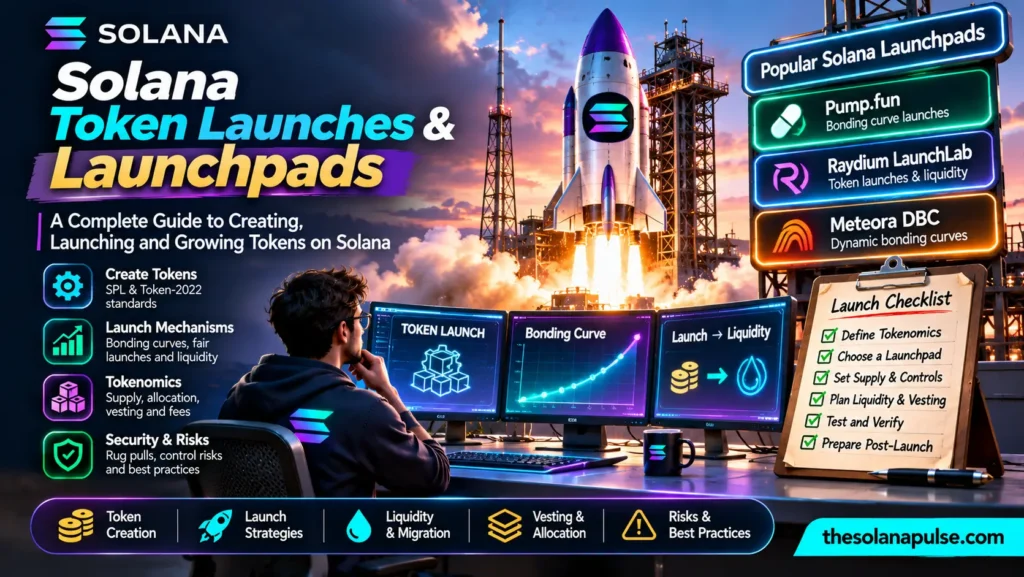
Create permissionless pools or launch tokens through LaunchLab, which can bootstrap liquidity through a bonding curve before migration.
Integrate Raydium programs, routing and market data through its SDK, APIs and onchain interfaces.
Raydium’s Main Products in 2026
It is useful to separate Raydium into distinct product families rather than thinking of it as one monolithic AMM.
| Product | What it does | Typical user | Main trade-off |
|---|---|---|---|
| CPMM | Standard constant-product automated market maker. | Passive liquidity providers and new permissionless pools. | Capital is spread across the full curve, so it can be less efficient near the current price. |
| CLMM | Concentrated-liquidity market making across selected price ranges. | Active LPs who want higher capital efficiency. | Positions require range management and can go out of range. |
| AMM v4 | Legacy/hybrid AMM architecture with OpenBook integration. | Long-established liquidity pools and legacy LP positions. | Older architecture; most new pools are better suited to newer programs. |
| Farm / Staking | Distributes additional token rewards to eligible liquidity positions. | LPs looking for incentives on top of trading fees. | Reward APRs vary and can fall when token prices or emission schedules change. |
| LaunchLab | Permissionless token-launch system using bonding curves before pool migration. | Creators and early token traders. | Permissionless launches carry very high token and creator risk. |
| Perpetuals | Leveraged perpetual-futures interface built with external infrastructure. | Advanced traders. | Leverage introduces liquidation and borrowing-cost risk. |
How Raydium Swap Works
A Raydium swap is a request to exchange one token for another using available Solana liquidity. The user chooses an input token, output token and amount. Raydium then evaluates eligible pools and prepares a transaction that produces the best available route under the current quote.
Raydium’s current user guide says the UI can display three broad route types: a single-pool swap, a multi-hop route, or a split route. A simple SOL/USDC trade might use one CLMM pool. A less direct trade could route SOL → USDC → RAY across two pools. A large trade can also be split between CLMM and CPMM liquidity to reduce price impact.
What happens when you press Swap?
The interface is simple; the routing decision underneath it can be much more complex.
Select the input token, output token and amount. Raydium reads current pool state and available balances.
The router evaluates output after fees and considers single-pool, multi-hop and split routes where appropriate.
The selected route is translated into Solana instructions and a minimum-received threshold based on slippage.
Your wallet authorizes the transaction. If execution stays within the permitted limits, the swap settles onchain.
Official source: Raydium Swap user flow ↗
How Raydium Chooses a Route
When multiple pools exist for the same pair, Raydium’s documentation says the router compares expected output after fees. If two pools produce similar results, liquidity depth matters because a deeper pool is more resilient to price changes before the transaction lands.
The router can also compare a direct route with a multi-hop path. Multi-hop routes introduce extra fee and execution complexity, so Raydium does not choose them just because they exist; they need to produce a better result. Large trades can be split between pools when that reduces overall impact.
This is one of the reasons Raydium should not be viewed as “one pool per token pair.” A pair can have several pools with different fee tiers or liquidity models, and the router can choose between them dynamically.
Raydium routes across Raydium liquidity. Jupiter is a broader Solana aggregator that can compare liquidity across multiple protocols, including Raydium. Both are useful, but they solve different parts of the routing problem.
Slippage, Price Impact and Minimum Received
Three numbers matter during a swap: the quoted output, the minimum amount you are willing to receive, and the expected price impact.
Slippage
Slippage tolerance defines how much worse the execution can become before the transaction should fail. Raydium’s user guide currently notes a default 0.5% setting in the UI, while stable pairs can tolerate much tighter settings and highly volatile or meme-token pairs may require wider tolerances.
A 0.5% tolerance does not mean the trade automatically loses 0.5%. It means the transaction is allowed to execute as long as the result does not fall below the minimum threshold implied by that tolerance.
Price impact
Price impact is different. It measures how much your own order changes the effective price because it consumes liquidity from the pool. A $100 swap in a deep SOL/USDC market may have negligible impact. The same trade in a tiny new token pool can move the price sharply.
Minimum received
Raydium calculates a minimum acceptable output from the quoted amount and slippage setting. If the available output drops below that minimum before execution, the transaction should revert rather than forcing a much worse trade.
Do not “fix” every failed swap by setting extreme slippage
A failed transaction is often telling you something useful: the market moved, liquidity is thin, or the token is highly volatile. Increasing slippage from 0.5% to a very large number may make the trade execute—but at a price you would never have accepted manually.
What Are Priority Fees?
Priority fees pay validators more to process a Solana transaction during periods of congestion. Raydium separates this from the pool’s trading fee. Paying a higher priority fee does not give you a better swap price; it increases the chance that your transaction lands before the quote becomes stale.
Raydium’s current swap documentation says the UI can automatically size priority fees and also offers faster tiers. If a volatile trade repeatedly expires before landing, raising priority may help. If the problem is poor liquidity or extreme price impact, priority fees will not solve it.
Raydium Fees Explained
Raydium does not have one universal swap fee. Different pool programs and configurations can use different fee tiers. Raydium’s current fee reference lists 0.25% as a common/default level, while CPMM and CLMM pools can use alternative tiers, including lower and higher rates.
Users should distinguish four possible cost layers:
- Pool trading fee: charged by the liquidity pool and used according to that pool’s fee configuration.
- Network fee: the Solana transaction fee.
- Priority fee: optional additional fee used to increase transaction landing priority.
- Token-2022 transfer fee: some tokens can charge issuer-defined transfer fees on top of pool fees.
The exact live quote matters more than a static article because fee configurations can change and different pools can use different tiers. Review the route and estimated fees in the interface before signing.
Official source: Raydium fee comparison ↗
What Is a Raydium CPMM Pool?
CPMM stands for constant-product market maker. It is the classic automated-market-maker design in which the relationship between the two token reserves follows a constant-product curve. In simplified form, the system tries to preserve:
x × y = k
where x and y represent the two token reserves. When a trader buys one token from the pool, the balance changes and the price moves along the curve.
For liquidity providers, CPMM is comparatively simple. You deposit two assets at the required ratio and receive LP tokens representing your share of the pool. As swaps occur, trading fees accumulate in the pool. When you later withdraw your share, the value of those fees is reflected in the assets you receive.
Raydium’s 2026 documentation describes CPMM as the default standard constant-product program for new pools and notes native Token-2022 support. That makes CPMM the practical baseline for many permissionless liquidity pools.
What Is a Raydium CLMM Pool?
CLMM stands for concentrated liquidity market maker. Instead of spreading liquidity across the entire possible price curve, the provider chooses a specific price range. Liquidity is active only while the market price remains inside that range.
This can make capital much more efficient. If SOL is trading near $150, an LP might choose to concentrate liquidity between $120 and $180 instead of allocating capital to prices near zero or thousands of dollars. More liquidity near the active market price can reduce price impact for traders and increase fee generation per dollar of active liquidity.
The trade-off is management risk. If SOL moves above $180 or below $120, the position becomes out of range. At that point, it stops actively market-making and no longer earns normal swap fees until the price returns or the LP repositions.
| Feature | CPMM | CLMM |
|---|---|---|
| Liquidity range | Across the full constant-product curve | Inside a user-selected price range |
| Management | More passive | More active |
| Capital efficiency | Lower near current price | Potentially much higher |
| Out-of-range risk | No range to leave | Yes; out-of-range positions stop earning normal active fees |
| Impermanent-loss sensitivity | Present | Can be amplified by concentrated ranges |
| Best suited to | Users seeking simpler LP exposure | Users comfortable managing ranges and market conditions |
How to Provide Liquidity on Raydium
At a high level, liquidity provision means depositing two assets into a pool so traders can swap between them. The exact interface differs by pool type, but the decision process should come before the deposit screen.
- Choose the token pair and verify both mint addresses.
- Identify whether the pool is CPMM, CLMM or legacy AMM v4.
- Review TVL, trading volume, fee tier and any active rewards.
- For CLMM, choose a price range and understand what happens if the market exits that range.
- Deposit the required token amounts.
- Confirm the transaction in your wallet.
- Track fees, rewards and position composition from the portfolio page.
The most common beginner mistake is choosing an LP position because the displayed APR looks high without asking why it is high. A large APR can be caused by temporary token incentives, very low liquidity, highly volatile assets or a reward token whose own price is unstable.
Impermanent Loss Explained Without the Jargon
Impermanent loss is the difference between holding two assets separately and providing them to an automated market maker while their relative price changes.
Suppose you provide SOL and USDC. If SOL rises sharply, traders buy SOL from the pool and leave more USDC behind. Your LP position gradually holds less SOL and more USDC. You may still profit in dollar terms, but you can end up with less value than if you had simply held the original SOL and USDC outside the pool.
The word “impermanent” can be misleading. The loss is only theoretical while the position remains open and prices can move back. Once liquidity is withdrawn, the portfolio composition is realised. Fees may offset some or all of the difference, but there is no guarantee.
Concentrated liquidity can magnify this effect because more of the portfolio conversion happens inside a narrower price band. That is the price of higher capital efficiency.
How to Think About CLMM Price Ranges
A narrow range concentrates liquidity close to the current price. If trading remains inside that band, the position can earn more fees per dollar than a wider position. But a narrow range is easier to leave.
A wide range is more forgiving. It remains active across larger price moves but spreads capital across more prices, reducing concentration near the current market.
There is no universally correct range. The choice depends on volatility, time horizon, how actively you can manage the position and whether the pair is correlated. A stablecoin pair can often use a tighter range than SOL versus a volatile token.
Narrow range vs wide range
Higher capital efficiency comes with a greater need to monitor the market.
More capital works near the current price. Potential fee efficiency is higher if price stays inside.
Your position gradually shifts toward one of the two assets as trades move through the range.
The position becomes one-sided and stops actively earning normal trading fees while price remains outside.
An active LP can close or adjust the position and choose a new range, accepting any realised portfolio changes.
How Raydium Farms Work
Farms add token rewards on top of trading-fee income for eligible liquidity positions. The mechanics depend on the pool type.
For CPMM pools, Raydium’s documentation says LP tokens can be staked in a farm. The LP must normally unstake those tokens before removing liquidity. For CLMM positions, farm rewards are distributed automatically to eligible in-range positions; separate LP-token staking is not required.
Rewards are not permanent. Farm emission schedules can start and end, and the displayed APR changes with token prices, total participating liquidity and the amount of rewards being distributed.
For CLMM users, there is another condition: the position must be in range to earn the relevant farm rewards. An out-of-range position can show an attractive historical APR while earning nothing at the current price.
Official source: Raydium Farms ↗
What Is Raydium LaunchLab?
LaunchLab is Raydium’s permissionless token-launch infrastructure. It allows creators to issue a token and bootstrap initial price discovery through a bonding curve. Buyers and sellers trade against that curve until the launch reaches its graduation target. Liquidity then migrates into a Raydium pool for normal AMM trading.
Raydium’s current documentation describes two broad creation paths. “JustSendit” is designed as a fast no-code launch with default-style parameters. The more configurable LaunchLab mode gives creators additional control over supply, graduation targets, curve allocation, vesting and creator-fee settings.
The key word is permissionless. Anyone can create a token. LaunchLab is infrastructure; it is not an investment-vetting service. A token’s presence on LaunchLab or Raydium does not prove that the team is legitimate, the supply is fairly distributed or the token has durable value.
How graduation works
Before graduation, buyers and sellers trade against the launch’s bonding curve. When the curve reaches the configured graduation condition, the bonding-curve phase closes and liquidity migrates into a Raydium AMM pool. Raydium’s docs say the exact post-migration path can depend on platform and creator-fee settings.
This transition matters because the market structure changes. Pre-graduation liquidity comes from the bonding curve. Post-graduation trading occurs through Raydium’s AMM infrastructure and can then be accessed by normal routing systems and aggregators.
Official source: LaunchLab overview ↗
Raydium and Token-2022 Assets
Solana’s Token-2022 program adds optional token extensions beyond the original SPL Token program. Some of these extensions can change how a token behaves during swaps or liquidity provision.
The most important user-facing example is a transfer fee. A Token-2022 mint can be configured so that every transfer pays a percentage to the token issuer or designated authority. If a swap involves a transfer-fee token, the user can pay that token-level fee in addition to the Raydium pool fee.
This is why a pool that advertises a 0.25% swap fee can still produce a materially larger total cost for a transfer-fee token. Raydium’s fee documentation illustrates how input and output transfer fees compound with normal pool trading fees.
Token-2022 also supports more advanced extensions, and not every extension is suitable for permissionless liquidity. Users should read the token’s configuration rather than treating every asset as a standard SPL token.
What Is the RAY Token?
RAY is Raydium’s ecosystem token. Historically it has been associated with protocol incentives, liquidity programs and governance-related functions across the Raydium ecosystem. Its market price is separate from the operational value of Raydium as a DEX.
Users should not assume that Raydium usage automatically creates a guaranteed investment return for RAY holders. Token value depends on market expectations, tokenomics, protocol economics and broader crypto conditions. If you are using Raydium simply to swap tokens, you do not need to buy RAY first.
Which Wallets Work With Raydium?
Raydium is a Solana application, so users interact through compatible Solana wallets. Phantom is one of the most common options, but it is not the only one. The main requirements are that the wallet supports Solana, can connect to Raydium’s interface and can correctly display transaction instructions for review.
If you are choosing a wallet, see our Best Solana Wallets 2026 comparison. If you already use Phantom, our Phantom Wallet Guide 2026 covers setup, recovery and transaction security in detail.
How to Swap on Raydium Safely
- Open the official raydium.io domain and bookmark it.
- Connect your Solana wallet.
- Select the input token and verify its mint address if it is unfamiliar.
- Select the output token and verify that mint too.
- Enter the amount.
- Review the route, pool fee, expected output and price impact.
- Check the minimum received and slippage setting.
- Review any Token-2022 transfer fee shown by the interface.
- Confirm the transaction in your wallet only if the asset changes make sense.
- After settlement, use the transaction link to verify the result on a Solana explorer if needed.
For unfamiliar or illiquid tokens, start smaller. A successful tiny test does not prove the token is a good investment, but it can catch simple operational errors such as selecting the wrong mint.
Raydium Security and Scam Prevention
- Use only raydium.io. Phishing sites can copy the interface almost perfectly.
- Never type your seed phrase or private key into Raydium.
- Verify token mint addresses instead of trusting token names and logos.
- Do not interpret a pool or route as an endorsement of the token.
- Check price impact before swapping into thin liquidity.
- Review the wallet simulation and token-balance changes before signing.
- Use conservative slippage on deep markets; high slippage can expose you to poor execution.
- Keep enough SOL for transaction fees and account creation where necessary.
- Consider a separate wallet for speculative LaunchLab or memecoin activity.
- For significant funds, consider hardware-backed signing and separate long-term storage.
Why a Raydium Swap Can Fail
Exceeded slippage
The market moved beyond your allowed tolerance. Requote, reduce the trade size or increase tolerance only modestly if the pair is genuinely volatile.
Transaction timeout
The priority fee may be too low for current network conditions. Increasing transaction priority can help a valid quote land faster.
Pool not found
New pools can take time to appear in indexed search. Refresh the app and search using the token mint or pool identifier.
Output is extremely small
The trade may be too large for available liquidity. Reducing size or using a different route can improve execution. If the token has almost no liquidity, there may simply be no reasonable trade.
Wallet balance did not update
If the transaction succeeded onchain, refresh the wallet and Raydium balances. Some wallets hide unfamiliar token accounts until manually enabled.
Raydium vs Jupiter: Which Should You Use?
Raydium and Jupiter are often compared as if one must replace the other. In practice, they occupy different layers.
Raydium is a liquidity protocol and DEX. It creates pools, hosts liquidity, runs AMM programs and lets users provide liquidity directly. Jupiter is primarily an aggregator and execution layer that can search multiple Solana liquidity sources, including Raydium.
| Use case | Raydium | Jupiter |
|---|---|---|
| Direct access to Raydium pools | Excellent | May route through Raydium indirectly |
| Compare multiple Solana protocols | Focused on Raydium liquidity | Core strength |
| Provide liquidity | Yes — CPMM, CLMM and legacy pools | Not its core role |
| Create a liquidity pool | Yes | No |
| Launch a token | LaunchLab | Different product focus |
| Best fit | LPs, creators and traders who want Raydium-native products | Traders primarily seeking broad route aggregation |
Who Should Use Raydium?
Everyday Solana traders: Raydium provides a direct way to swap tokens and inspect the route being used.
Liquidity providers: Raydium is particularly relevant to users who want direct access to CPMM and CLMM positions rather than only swapping through an aggregator.
Advanced LPs: Concentrated-liquidity pools give experienced users more control over capital efficiency and market-making ranges.
Token creators: Permissionless pool creation and LaunchLab provide infrastructure for launching tokens and bootstrapping liquidity.
Developers: Raydium’s SDKs, APIs and onchain programs allow builders to integrate swaps and market data into other Solana products.
Raydium Pros and Cons
Deep integration with Solana DeFi, multiple liquidity models, route splitting, permissionless pools, active liquidity management through CLMM, farming incentives, Token-2022 support and a token-launch stack through LaunchLab.
Liquidity provision introduces impermanent loss; CLMM requires active management; permissionless tokens can be scams; fees vary by pool; Token-2022 can add hidden complexity; and leveraged products are not suitable for beginners.
Raydium FAQ
Is Raydium a decentralized exchange?
Yes. Raydium is a Solana DEX and liquidity protocol. Users connect a wallet and sign onchain transactions instead of depositing assets into a traditional centralized exchange account.
Does Raydium hold my funds?
Normal swaps and liquidity interactions are wallet-based and self-custodial. Raydium should never need your wallet seed phrase or private key.
What is the difference between CPMM and CLMM?
CPMM spreads liquidity across the full constant-product curve. CLMM lets providers concentrate liquidity inside selected price ranges, which can improve capital efficiency but requires more active management.
What happens when a CLMM position goes out of range?
The position stops actively market-making while price remains outside the chosen range. It generally stops earning normal trading fees and applicable in-range farm rewards until price returns or the LP repositions.
What is impermanent loss?
It is the difference between the value of an LP position and simply holding the underlying tokens separately after their relative price changes. Fees can offset it, but not always.
Does Raydium always charge 0.25%?
No. 0.25% is a common/default tier, but Raydium supports several fee configurations depending on the pool type. Token-2022 transfer fees and Solana network fees can also add cost.
Can Raydium route through multiple pools?
Yes. Raydium’s current documentation describes single-pool, multi-hop and split routes. Large trades can be divided across pools when doing so improves expected output.
Is every token on Raydium safe?
No. Raydium is permissionless and anyone can create tokens and pools. Always verify the mint address, liquidity and project source before trading an unfamiliar asset.
What is LaunchLab?
LaunchLab is Raydium’s permissionless token-launch infrastructure. New tokens can trade on a bonding curve and later graduate into Raydium AMM liquidity.
Is Raydium better than Jupiter?
They serve different purposes. Raydium is a DEX and liquidity venue; Jupiter is a broader aggregator that can route through Raydium and other Solana liquidity sources. The better choice depends on whether you want direct Raydium products or cross-protocol routing.
Do I need RAY to use Raydium?
No. You normally need SOL for Solana transaction fees and the assets involved in your transaction. You do not need to own RAY simply to make a swap.
Final Verdict: What Raydium Is Best At in 2026
Raydium remains one of the clearest examples of how broad Solana DeFi infrastructure has become. It is no longer just a simple token-swap page. Under one ecosystem sit passive constant-product pools, concentrated-liquidity positions, farms, permissionless pool creation, token launches, routing and other trading products.
For ordinary traders, the most useful feature is straightforward: Raydium can compare its available pools and construct a route without requiring the user to manually inspect each market. For liquidity providers, the deeper value is choice. CPMM offers a simpler passive model, while CLMM lets active users concentrate capital around prices they believe are likely to trade.
The protocol’s flexibility also creates risk. Permissionless listings mean scam tokens can appear. High LP yields can hide impermanent loss or unstable reward tokens. Concentrated liquidity can go out of range. Token-2022 can add transfer fees. And no interface can protect a user who signs a malicious transaction or visits a fake domain.
The best way to use Raydium is therefore not to treat it as a “yield app,” but as market infrastructure. Understand which pool or product you are using, verify the token, review the route, check the fees and price impact, and choose a liquidity strategy only after you understand how the position changes when the market moves.