
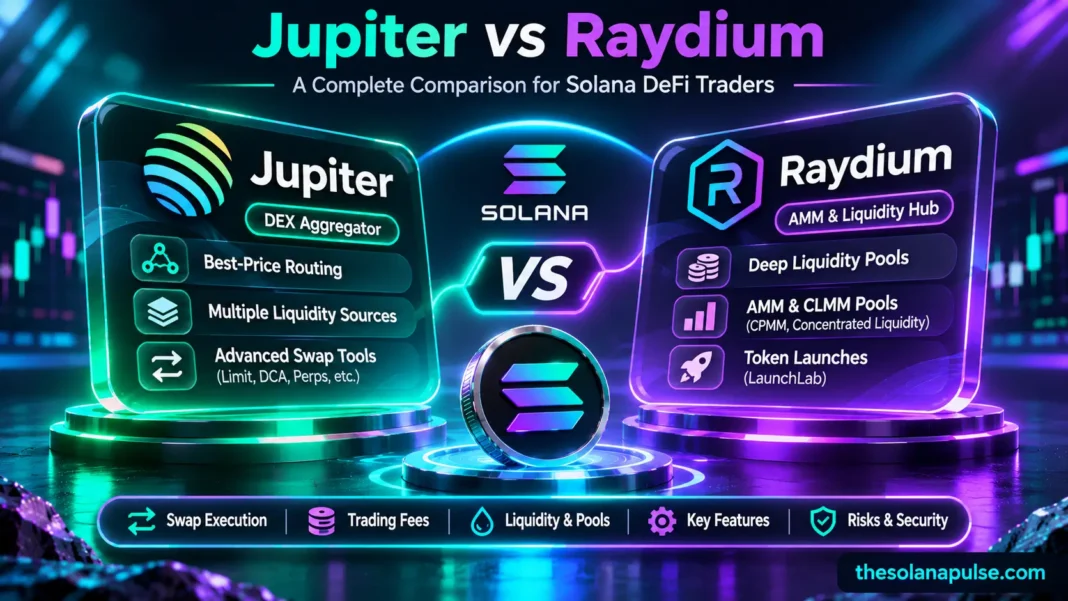
Jupiter and Raydium are two prominent names in Solana decentralized finance, but comparing them as if they were two identical exchanges misses the most important difference. Jupiter primarily helps traders discover and execute swaps across available liquidity sources. Raydium operates automated market maker programs, offers a direct trading interface, and provides tools for supplying liquidity and launching tokens. A transaction initiated through Jupiter may actually trade against a Raydium pool.
For an ordinary spot swap, Jupiter is a useful place to begin comparing execution options. For users who want to inspect a particular Raydium pool, manage a concentrated liquidity position or create a new market, Raydium offers a different set of tools. Neither platform can guarantee the best price, safe assets, successful execution or profitable returns in every situation.
This comparison is part of the Solana DeFi Hub. It focuses on choosing between the two products for a specific task rather than repeating the individual Jupiter Exchange and Raydium Complete Guide guides. Research reviewed on 24 November 2026. Product availability, fee schedules, integrations and interfaces may change. All numerical trading scenarios are hypothetical and do not represent live quotes or recommendations to buy any asset.
- Jupiter discovers routes and competing execution sources; Raydium supplies its own liquidity infrastructure and direct product interfaces.
- A Jupiter swap can execute through Raydium, so their trading activity is not mutually exclusive.
- Compare final expected output, minimum received and separately paid costs at the same trade size, not advertised fees alone.
- Raydium pool fee rates vary by pool and configuration. Jupiter fees depend on product and execution mode.
- Liquidity provision on Raydium and trading through Jupiter are different economic activities with different risks.
- Neither a token listing nor a successful transaction proves that an asset is legitimate or that a trade is profitable.
- Identify the task: immediate spot swap, controlled execution, liquidity provision or pool creation.
- Open the official platform through a verified bookmark; never use a link sent by an unsolicited account.
- For a swap, select the identical verified token mints, direction and amount on both platforms.
- Compare fresh quotes, expected output, minimum received, route details and separate transaction costs.
- Choose only an acceptable quote; verify wallet instructions and reject unexpected permissions before signing.
- Check the confirmed transaction and actual balance changes. For liquidity positions, review the pool configuration and withdrawal conditions before depositing.
1. Jupiter vs Raydium at a Glance
| Feature | Jupiter | Raydium |
|---|---|---|
| Core role | Swap discovery and execution across supported sources | AMM liquidity programs and associated products |
| Spot swaps | Multiple eligible routes; RFQ in supported modes | Raydium interface and pool-based routing |
| Liquidity source | External venues and participating market makers, depending on mode | Assets supplied to Raydium pools |
| LP positions | Not the same as supplying liquidity to a Raydium pool; separate Jupiter products exist | CPMM and CLMM positions, plus legacy pool types |
| Automation | Trigger orders and recurring execution products | Pool-centric trading and liquidity management |
| Token launch | Not a substitute for Raydium pool creation | LaunchLab and pool creation tools |
| Trading cost | Depends on route, mode, fees and execution | Depends on pool config, route and token rules |
| Best evaluated by | Net executable quote and supported workflow | Pool economics, net quote and position requirements |
This table compares product functions, not the financial performance of JUP or RAY. The platforms operate at different layers of the same market. Jupiter can offer a more convenient discovery experience when a user does not know which venue has sufficient liquidity. Raydium can be more relevant when the user already knows the pool or wants to become a liquidity provider rather than simply exchange tokens.
The distinction also matters when discussing competition. A routing service can send trade flow to a pool, generating fees for that pool’s participants. At the same time, the routing service may compete with the pool’s direct interface for user attention. Both relationships can exist together. The correct comparison is therefore between execution choices and product functionality rather than a simple ranking of brand names.
2. Why Jupiter and Raydium Can Be Part of the Same Trade
A spot swap interface prepares a transaction that a wallet can authorize. Behind that interface is a source of executable liquidity. When Jupiter selects a Raydium pool, Raydium’s program may determine how assets are exchanged while Jupiter provides discovery and execution coordination. If a different source offers more attractive terms, Jupiter can choose another eligible route instead. The user does not need to create a Raydium account merely because a route contains a Raydium program.
Jupiter’s current Swap API documentation distinguishes a managed Meta-Aggregator path from a more customizable Router path. The former evaluates multiple eligible engines, including RFQ quotes; the latter exposes instructions from its on-chain routing engine for integration into a custom transaction. These are developer-level paths, not a promise that every consumer interface displays identical settings.
Raydium’s product overview describes a family of on-chain exchange and liquidity products. Its interface and developer infrastructure make those products accessible. A direct Raydium quote may involve more than one pool; direct platform use should not be confused with a guarantee that exactly one pool is involved.
Illustrative example of an SOL-to-USDC trade.
Routing discovers an eligible Raydium pool.
The user reviews the proposed output and signs.
The pool executes the applicable swap instructions.
The wallet receives the resulting tokens on Solana.
A trader using Raydium directly may reach the same pool through a different interface. Routes and settlement terms can vary.
3. Where Jupiter Has a Practical Advantage
Jupiter’s strongest use case is execution discovery when the trader wants to exchange one asset for another and does not have a reason to choose a specific pool. Liquidity can be fragmented across venues. Looking at one pool in isolation may miss a better combination of depth, pricing and fees elsewhere. An aggregator can automate much of this search, reducing the burden on the user.
A route may exchange the input directly, pass through an intermediate asset or allocate parts of a trade to different sources. Route complexity is not a measure of quality by itself. A simple route with deep liquidity may produce a better outcome than a multi-step route, while a carefully chosen combination of pools can improve a larger order. The useful result is the executable net output for the intended amount, subject to the user’s risk limits.
The managed execution path can also reduce some operational work for developers who do not want to build their own transaction submission pipeline. This should not be interpreted as a guarantee that an order lands. A stale quote, changed market conditions, an expired transaction or an unavailable execution source can still prevent completion. The user should verify the resulting signature rather than assuming a successful interface notification is definitive.
Jupiter’s broader trading tools are useful for users who need conditional or scheduled execution. These workflows have their own eligibility, fee, custody and cancellation rules. Someone who wants to buy or sell only at a chosen price should evaluate the relevant order product instead of repeatedly submitting immediate swaps. The availability of a feature is not a reason to use it when a simple trade is sufficient.
4. Where Raydium Has a Practical Advantage
Raydium is especially relevant when the object of research is a particular liquidity market. A user may want to examine the assets a pool contains, its fee tier, its liquidity distribution or the history of an existing position. Those questions require pool-level information, not merely a quote for a token pair. A direct pool interface can make these properties more accessible.
Raydium’s constant-product pools and concentrated liquidity pools represent different ways of making assets available for trade. With a conventional full-range position, inventory remains available across the pricing curve. With a concentrated position, liquidity is assigned to a selected range; the position may become one-sided when the price moves out of that range. Selecting a pool model is an investment and inventory-management decision, not just an interface preference.
For creators, the pool creation and LaunchLab workflows address a problem that a swap aggregator does not solve by itself: establishing a market and making assets available for trading. Creating a market requires decisions about asset identity, initial price, funding, fee configuration and ongoing liquidity. A token being tradable after launch is not evidence of sound economics, honest management or adequate liquidity for future sellers.
A user trading an established pair may find a competitive direct quote on Raydium. The direct option can also be valuable as an independent comparison when the user wants to understand whether an aggregator’s additional service costs are justified. However, direct trading is not inherently cheaper and should not be selected merely to avoid an assumed intermediary fee.
5. Jupiter vs Raydium Fees: Compare the Right Numbers
Fee comparisons are often misleading because different platforms report different components of a trade. A pool charge compensates participants or supports protocol revenue. A platform or routing charge pays for a product or service. Solana network charges cover transaction processing. A token may have its own transfer rules. An interface can show some of these in the quoted output and others separately. Adding an already deducted fee a second time exaggerates the cost.
As documented on the research date, Jupiter’s managed order path has pair-dependent platform fees. Its raw-instruction routing path has no Jupiter swap fee, although other costs can still apply. Read the order and execution fee documentation for the actual product fields and current rules. A developer API fee policy is not automatically the fee policy of every wallet integration or Jupiter product.
Raydium’s protocol fee documentation describes pool charges and their distribution. A common example uses a 0.25% fee, but this is not a universal fee for every pool. In the documented ordinary CPMM and CLMM split example, 84% of the trading fee goes to liquidity providers, 12% to RAY buybacks and 4% to treasury. Those percentages apply to the fee itself, not the entire trade amount. Additional creator or token fees can follow different rules.
| Cost component | What to check on Jupiter | What to check on Raydium |
|---|---|---|
| Pool or market cost | Included market execution economics in the quote | Pool fee tier and actual quote |
| Platform charge | Selected mode, pair and integration terms | Applicable product charges and configured fees |
| Network cost | Fee payer, priority fee, any tip or sponsorship terms | Network fee, priority fee and fee payer |
| Account creation | Whether output account setup is needed or sponsored | Whether new token or position accounts are needed |
| Token rules | Transfer fee and supported extensions | Transfer fee and supported extensions |
| Price impact | Net quoted output relative to reference price | Depth and quoted output at the requested size |
A wallet with an existing USDC account might not need to pay the same account-creation deposit as a new wallet. A sponsored transaction might reduce the amount of SOL a user must hold for the immediate trade, but the economics of sponsorship should be examined rather than presumed free. Some storage deposits may be recoverable when the relevant account is legitimately closed; until then, those funds are unavailable for other uses. The Solana Transaction Fees guide explains these costs separately.
For comparisons, establish one measurement currency and use a consistent valuation time. A SOL charge cannot simply be added to a USDC charge as if the units were identical. Convert it using the same reference SOL price for both choices. If the output already includes the platform and pool charges, subtract only the separate costs still paid by the wallet. Keep recoverable storage deposits separate from irrecoverable costs when comparing longer-term economics.
6. Practical Example: Which Quote Is Actually Better?
Imagine a user selling 10 SOL with a reference valuation of 100 USDC per SOL. The reference notional is 1,000 USDC. The user obtains two quotes at approximately the same time, with the same verified SOL and USDC assets. Both examples already deduct any embedded trading charges. The amounts are fictional and have been chosen to demonstrate a comparison method, not a market result or a fixed relationship between the platforms.
| Quote field | Jupiter example | Raydium example |
|---|---|---|
| Input | 10 SOL | 10 SOL |
| Expected output after embedded fees | 996.50 USDC | 995.80 USDC |
| Illustrative minimum output | 994.00 USDC | 993.30 USDC |
| Separately paid network cost (converted) | 0.15 USDC | 0.05 USDC |
| Expected output less separate cost | 996.35 USDC | 995.75 USDC |
| Shortfall from reference notional | 3.65 USDC | 4.25 USDC |
In this example, the Jupiter route has a net advantage of 0.60 USDC even though its separately paid network cost is higher. That is only 0.06% of the reference notional. A modest change in either quote could reverse the result. If the Raydium quote improved to 996.70 USDC with the same separate cost, its net amount would become 996.65 USDC, exceeding the original Jupiter example by 0.30 USDC.
The minimum output is a separate protection threshold, not a prediction of the final output. In this scenario a user who considers anything below 994 USDC unacceptable would need to check whether the minimum and any separate charges satisfy that requirement. A better expected output with a much worse permitted minimum may not suit a user who prioritizes cost certainty. Quotes also expire or become stale, so the comparison should be refreshed immediately before authorization.
The reference notional is a diagnostic benchmark rather than an executable price. It helps quantify the total shortfall relative to a common reference, but it does not establish exactly how much of that shortfall came from each pool charge, spread or price impact. The detailed route and fee information is needed to attribute costs accurately.
7. Small Swaps, Large Swaps and Thin Liquidity
For a small trade in a familiar pair, the difference between two well-functioning interfaces may be less significant than the user’s ability to review the transaction accurately. A few cents of apparent savings are not worth granting an unfamiliar application broad permissions or switching to a suspicious website. Convenience is a legitimate comparison factor, as long as it does not replace checking the asset and output.
A larger trade changes the comparison. The amount of usable liquidity at the current price becomes more important than total value locked across an entire protocol. A large pool can still have limited depth in the relevant direction, especially if concentrated liquidity is positioned away from the current price. Jupiter may discover alternative liquidity, but if most available routes depend on one shallow market, aggregation cannot create depth that does not exist.
Breaking an order into smaller transactions can sometimes alter execution economics, but it also increases the number of fees, introduces timing risk and can leave a user holding a partially completed position. Splitting the trade is not the same as an atomic split route inside one transaction. A useful comparison records the intended full amount, the maximum acceptable cost and what happens if only part of the trade is executed.
For a thinly traded token, a reverse quote can be more informative than a headline purchase quote. An asset may be easy to acquire because a pool has substantial token inventory, but difficult to sell because the pool has little of the desired exit asset. The ability to quote a buy does not establish a viable exit. Verify token rules and test the reverse direction with a reasonable size before taking exposure.
8. A Side-by-Side Spot Swap Workflow
- Open Jupiter at its verified official domain and Raydium at its verified official domain. Use a dedicated trading wallet if appropriate.
- Confirm the same input and output mint addresses on both interfaces. Do not rely on a ticker alone.
- Enter the same exact input amount. Compare fresh output estimates without signing either transaction.
- Review route information where available, fee disclosures, minimum output and any account-creation requirement.
- Choose one route only if it meets your predefined conditions. Refresh the quote, check the signing request and authorize once.
- Record the signature and actual output. Do not submit the second transaction just because the comparison interface is still open.
This workflow does not require transferring funds between Jupiter and Raydium. In a typical wallet-authorized spot trade, the wallet supplies the assets and signs the transaction. The interfaces can be compared before a trade is authorized. If a website demands that a seed phrase or private key be entered to obtain a quote or connect a wallet, stop immediately.
The order of operations matters. Checking the token mint after signing is too late to avoid a mistaken purchase. Comparing one quote in the morning with another hours later measures market changes as well as venue differences. Submitting both transactions to see which is better creates two real trades and changes the amount of exposure. The safest comparison is read-only until the decision has been made.
9. Instant Swaps vs Conditional and Recurring Orders
Immediate swaps and conditional orders solve different problems. An immediate swap attempts to execute based on the present quote. A conditional order expresses a price or other execution condition and may stay open until that condition is satisfied, canceled or expired. It can remain unfilled even when a chart briefly displays the target price, because executable liquidity and the actual order rules matter.
Jupiter’s Trigger documentation describes vault-based order functionality, including conditional orders and recurring execution. Its older Recurring API documentation identifies that API as superseded by a newer DCA product. Users should use the currently supported interface rather than assuming a historical product name still maps to an active service.
A scheduled order divides a planned exchange across time; it does not remove market risk or guarantee a better average price. Before creating one, understand which assets are committed, how cancellation works, whether unused balances can be withdrawn and how the service charges each execution. A price-controlled order also needs a clear understanding of partial fills and expiration behavior where applicable. These questions are different from comparing two immediate swap quotes.
Raydium’s main liquidity-management workflows solve another problem: maintaining market inventory. Placing liquidity within a price range can produce inventory changes that resemble trading, but it is not equivalent to submitting an ordinary limit order. A liquidity provider can continue to be exposed to changing prices and may need to manage the position over time.
10. Liquidity Provision: Raydium vs Jupiter Products
Raydium allows users to provide assets to its pool programs. The economic objective is to make liquidity available to traders and potentially collect a share of fees. A provider’s result depends on the deposited pair, market activity, position range, fee configuration and changes in asset values. It is not a passive fixed-income deposit, and the value recovered may be lower than the value of simply holding the original assets.
Jupiter has separate financial products beyond spot aggregation. Their collateral, portfolio and revenue mechanics should be evaluated independently. A product associated with perpetual trading, for example, may expose liquidity providers to trader profit and loss, inventory changes and other risks that are not equivalent to a Raydium SOL/USDC liquidity position. The presence of liquidity-related features on both platforms does not make their positions interchangeable.
Suppose a hypothetical Raydium pool processes 100,000 USDC equivalent of volume at a uniform 0.25% trading fee under the ordinary documented split used earlier. The aggregate fee is 250 USDC equivalent, of which 210 would be allocated to liquidity providers under those assumptions. A provider entitled to 1% of that LP fee allocation would receive 2.10 USDC equivalent. The allocation does not imply that the provider owns 1% of the protocol or has earned a positive net return. For concentrated liquidity, the relevant fee share can depend on which liquidity was active at execution.
The example deliberately excludes inventory changes, rewards, position management and network costs. A meaningful evaluation requires the value of the position after those effects and a comparison with the value of the same initial assets under an alternative strategy. Avoid comparing a displayed LP APR to a swap fee or to a staking APY: they represent different quantities and economic activities.
| Position or task | Important measurement | Main risk |
|---|---|---|
| Raydium CPMM position | Reserve share, fee income and net withdrawal value | Asset divergence and market exposure |
| Raydium CLMM position | Active liquidity, range, collected and uncollected fees | Out-of-range inventory and management cost |
| Jupiter spot swap | Actual output relative to input and costs | Price impact and route execution |
| Jupiter conditional order | Executed amount, remaining funds and order terms | Non-execution, custody and cancellation conditions |
| Separate derivatives liquidity product | Product-specific asset exposure and counterparty economics | Trader P&L, collateral and protocol risk |
11. Token Launches, New Markets and Asset Discovery
Raydium’s launch tooling and pool creation infrastructure are relevant to projects establishing a trading market. Before graduation from a launch mechanism into another market structure, the fee rules and liquidity arrangement may differ from those of a mature pool. A trader should determine which program and market actually handle the transaction rather than assume every trade on a familiar interface uses the same model.
Jupiter may make a new asset discoverable once eligible routing sources support it. Discovery is not the same as issuing the token, vetting the creator or guaranteeing the market. Even if the same token is visible on both platforms, its mint may have administrative authorities, transfer restrictions or a highly concentrated distribution. These factors are independent of the interface providing access.
For creators, initial pricing and liquidity funding deserve careful planning because they determine early trading conditions. For buyers, the key research questions are whether the mint is correct, who controls relevant token permissions, whether exits are feasible and how concentrated the available liquidity is. A newly created pool with a dramatic quoted price change can reflect shallow depth rather than broad market demand. Neither platform’s brand should be treated as an endorsement of the token.
12. Security and Execution Risks: What Each Layer Adds
Both platforms require trust in parts of their software and infrastructure. A Jupiter route can depend on routing services and the underlying programs it invokes. A Raydium trade or deposit can depend on the pool program, its configuration and the token contracts. Both may depend on a wallet, RPC connectivity and the Solana network. A problem at one layer can affect execution even when the others are working.
An aggregate route does not remove the risk of an underlying venue. A direct trade does not remove the risk of signing incorrect instructions. Program audits are useful evidence, but they do not guarantee that every deployed version, configuration or integration is safe. When evaluating a product, check the specific program and release, known security disclosures, upgrade controls and the limits of any security review.
MEV and execution uncertainty can affect both types of trade. Higher slippage tolerance may permit a larger deterioration from the quote, while excessively restrictive tolerance can cause a trade to fail when prices move. A managed submission service or execution protection feature may reduce certain risks but is not universal protection. Avoid adjusting settings simply to force through an unfamiliar asset purchase.
The Solana Wallet Security guide explains wallet authorization in more detail. Use a wallet containing only the funds needed for the activity, verify the destination and asset changes in the signing request, and avoid unexplained delegation or authority changes. Disconnecting a site is not a substitute for inspecting permissions already granted on-chain.
Security warning — never pay a recovery or unlock fee to a stranger
Neither a genuine swap nor ordinary liquidity management requires sharing a recovery phrase. If a transaction fails, use the official documentation and a public transaction signature for troubleshooting. Never authorize an unrelated transfer because a support impersonator promises to release funds.
13. How to Verify the Result in Solscan
After signing a trade, the important evidence is its transaction signature and actual result, not the quote that preceded it. Open the signature in a trusted explorer and inspect whether the transaction succeeded, the token mints involved, the wallet’s pre- and post-transaction balances and the fee charged. The How to Use Solscan walkthrough explains where to find these records.
When an aggregate route uses Raydium, program instructions may show both routing and pool-related activity. This is not automatically a duplicate trade. A single swap can invoke multiple programs and create or close temporary accounts. Balance changes should be reconciled across the transaction, rather than counting every instruction as an independent sale.
If the trade appears missing, first verify that the wallet and network are correct. A submitted transaction may not have landed, or the interface may have stale state. A processed failed transaction can still incur network charges. Check the signature before retrying, especially when a duplicate successful trade would create unwanted exposure.
Use actual settled outcomes rather than screenshots of estimated quotes.
Save the transaction signature and intended input.
Check success, program calls and token mints.
Compare actual balance changes and separate fees.
Calculate net outcome and note any discrepancies.
One transaction may contain multiple instructions; do not count each instruction as a separate trade.
14. Which Platform Should You Use?
| Your objective | Useful starting point | Decision rule |
|---|---|---|
| Swap an established pair | Jupiter and a direct Raydium quote | Choose acceptable net output and execution terms |
| Inspect a Raydium pool | Raydium | Verify exact pool, assets, fee tier and depth |
| Supply concentrated liquidity | Raydium | Understand range, inventory and withdrawal mechanics |
| Automate a conditional trade | Jupiter order products | Check execution conditions, fees and cancellation |
| Create a new liquidity market | Raydium pool tools | Check funding, program settings and creation costs |
| Buy a newly launched token | Neither by default | Research mint, restrictions and exit liquidity first |
The most reliable decision process starts with the task rather than the platform. A person who intends to exchange a familiar asset today should prioritize quote quality, security and settlement. Someone researching a new pool should prioritize its configuration, reserves and executable depth. Someone providing liquidity should evaluate inventory exposure and operational costs instead of asking which swap interface is cheaper.
There is no need to select a permanent winner. A user can compare Jupiter and Raydium for each trade, while using a pool interface for position management. If neither route meets the planned cost or risk limits, declining the trade is a valid outcome. Treat convenience and brand familiarity as useful secondary considerations rather than evidence that the economics are favorable.
15. Frequently Asked Questions
Is Jupiter better than Raydium?
Jupiter is useful for comparing execution sources, while Raydium is useful for pool-specific trading and liquidity management. The better choice depends on the task and quote.
Does Jupiter use Raydium liquidity?
It can when the applicable routing engine supports and selects an eligible Raydium pool. Not every Jupiter trade uses Raydium.
Which has lower fees?
There is no universal answer. Compare net output and separate costs using the same assets, amount and quote time.
Do I need JUP or RAY to trade?
Typically no for ordinary swaps. Token ownership and application eligibility may matter for separate products; check the actual fee payer and workflow.
Can I provide Raydium liquidity through a normal Jupiter swap?
No. Swapping and establishing an LP position are different actions, even if the swap executes against a Raydium pool.
Is a zero platform fee a free trade?
No. Pool economics, network charges, token transfer fees or other costs may still affect the outcome.
Can I compare quotes without spending funds?
Ordinary quote requests do not require executing a trade. Avoid signing unnecessary transactions just to compare prices.
Is Jupiter always better for large orders?
No. It may find more eligible liquidity, but the final outcome depends on available depth, route costs and market conditions.
Does a Raydium listing prove a token is genuine?
No. Verify the mint and issuer controls independently, regardless of which interface lists the asset.
Can either platform guarantee a limit order will fill?
No. Execution depends on the order conditions, available liquidity and the supported product rules.
Why does Solscan show both Jupiter and Raydium?
A routed transaction may call a Raydium pool through Jupiter. Inspect the signature and actual balance changes to understand the result.
Which is safer for beginners?
Neither is risk-free. A familiar, verified interface with understandable instructions and a modest trade size can reduce avoidable mistakes, but underlying asset and program risks remain.
16. Final Takeaway
Jupiter and Raydium are complementary as well as competing products. Jupiter helps discover and coordinate execution; Raydium provides liquidity infrastructure and pool-focused tools. Compare spot swaps using the same inputs and net output, and assess liquidity positions on their own economic terms. No interface can guarantee a favorable trade or remove the risk of a token.
Continue learning through our Solana DeFi Hub for related guides on Solana trading and liquidity.
17. Official Research Sources
- Jupiter Swap API overview
- Jupiter managed execution and fees
- Jupiter Trigger order documentation
- Jupiter legacy Recurring API status
- Raydium official documentation
- Raydium product overview
- Raydium protocol fees
- Raydium CPMM fee configuration
- Raydium user FAQ