
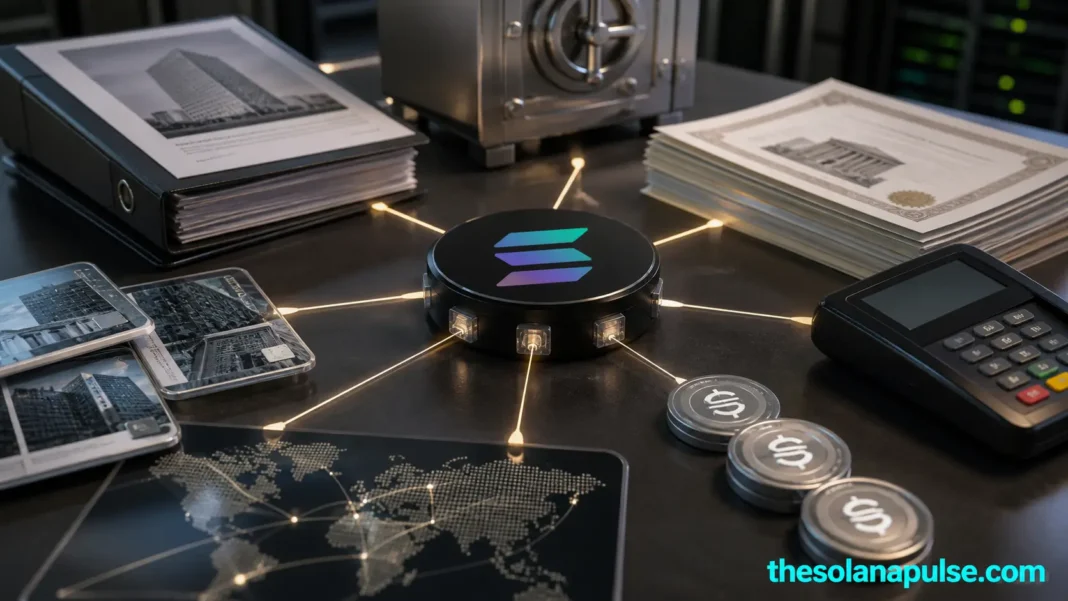
Solana, a blockchain known for its superior speed and scalability, is making significant strides in the institutional landscape. Recent developments involving BlackRock and Western Union suggest a pivotal moment for Solana as it becomes a foundational infrastructure for tokenized assets and high-volume payments, marking a shift in how traditional finance integrates with blockchain technology.
The Story
BlackRock, one of the world’s largest asset managers, has filed with the U.S. Securities and Exchange Commission (SEC) to issue tokenized shares of its BRSRV fund on the Solana blockchain. This marks a major step in institutional adoption of blockchain technology, signaling a growing interest in utilizing public blockchains for regulated financial products. Tokenizing fund shares on Solana allows traditional financial instruments to be integrated into decentralized applications, offering new programmable financial opportunities.
Meanwhile, Western Union has launched its USDPT-powered Stablecard in collaboration with Rain, serving 37 markets. The card, leveraging stablecoin infrastructure, demonstrates Solana’s potential to facilitate consumer payments by connecting blockchain technology with everyday financial transactions.
Strategic Rationale
The move by BlackRock to tokenize its fund shares on Solana is not just about leveraging blockchain technology; it’s about creating a seamless bridge between traditional finance and digital assets. By allowing fund shares to be traded on the blockchain, BlackRock is pioneering a new era of financial products that are not only more accessible but also more integrated with the digital economy. This positions Solana as a preferred blockchain for institutional-grade financial services.
For Western Union, integrating stablecoin infrastructure into its payment systems offers a faster, programmable solution for cross-border transactions. This not only enhances efficiency but also aligns with the growing trend of digital payments, providing a robust alternative to traditional fiat currency exchanges.
Ecosystem Implications
Solana’s ability to process over 1.01 billion non-vote transactions in a single week underscores its capacity to handle high-volume activities, a critical factor for supporting institutional-scale operations. This capability not only attracts financial giants like BlackRock and Western Union but also sets a precedent for other institutions considering blockchain technology for their operations.
The integration of tokenized assets and stablecoins into Solana’s ecosystem can lead to a more dynamic financial environment where digital assets and traditional financial systems coexist, offering new avenues for growth and innovation.
Competitive Positioning
As Solana gains traction in the institutional sector, it presents a formidable challenge to other layer-1 networks like Ethereum. While Ethereum has been a go-to for many decentralized finance applications, Solana’s speed and efficiency make it a compelling alternative for large-scale financial transactions. The collaboration with high-profile institutions enhances Solana’s reputation and positions it as a viable contender in the race for blockchain supremacy.
However, the true test will be whether Solana can maintain this momentum and continue to attract institutional interest while addressing any scalability issues that may arise as adoption increases.
Solana’s blend of speed and scalability positions it as a strategic partner for institutions exploring blockchain integration.
Editor’s Insight
TheSolanaPulse observes that Solana’s strategic partnerships with BlackRock and Western Union highlight a new phase of institutional engagement. This development is a testament to Solana’s evolving role in the global financial ecosystem and its potential to redefine the boundaries of blockchain adoption.
Looking ahead, Solana must ensure it can support increased transaction volumes without compromising performance, as this will be critical in sustaining institutional interest and expanding its reach in the financial sector.