
Solana gaming is best understood as a spectrum rather than one genre. At one end are conventional games that use Solana only for player-owned items or payments. At the other are fully onchain games where important game actions, inventories, economies or state changes are recorded and enforced by blockchain programs.
That distinction matters because a good blockchain game does not need to put every frame, animation or combat calculation onchain. Solana is most useful where a game benefits from shared ownership, open marketplaces, persistent assets, programmable economies, verifiable game state or interaction with other applications.
Solana’s official game-development materials describe those same advantages: player-owned assets through NFTs, open and composable in-game economies, programs that can interact with other Solana applications, and transaction costs low enough for small-value digital items or USDC micro-payments.
The network’s current gaming page highlights titles including Star Atlas, Aurory and Genopets. Star Atlas is a particularly useful example because its ecosystem shows several different blockchain-gaming models at once: SAGE is a browser-based fully onchain 4X strategy experience, while its Unreal Engine 5 experience uses blockchain-integrated assets around a traditional high-fidelity game client.
This page is the main Solana Gaming authority hub for TheSolanaPulse. It explains how wallets, game state, NFTs, compressed assets, currencies, marketplaces, DeFi and gaming infrastructure fit together without turning the pillar page into a random “top games” list.
Primary source: Solana — Gaming ↗
- Not every game needs to be fully onchain. A game can use Solana only where ownership, settlement or verifiability adds value.
- Wallets can act as player identity. Players can authenticate and control assets through a Solana wallet instead of relying entirely on one game company’s database.
- Game items can become portable digital assets. Weapons, characters, land, achievements and collectibles can be represented through NFTs or other token standards.
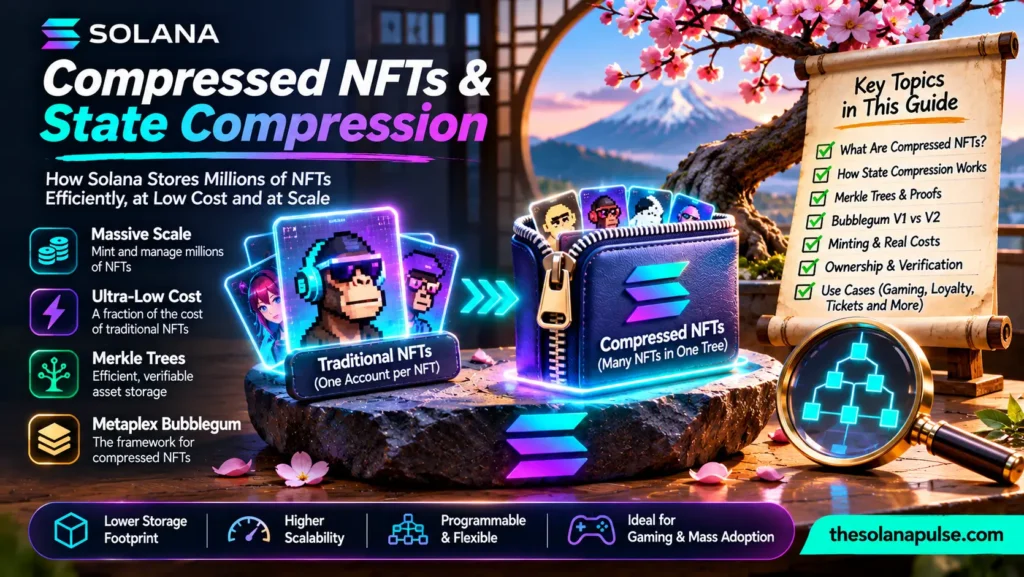
- Compressed NFTs change the scale equation. Bubblegum V2 can mint very large asset sets at a tiny per-item cost after the tree is created.
- Game state can live onchain. Solana program accounts can store player state such as health, energy or progress when the game benefits from verifiability.
- Economies can connect to the broader ecosystem. Game tokens and assets can potentially interact with wallets, marketplaces and DeFi protocols.
- Player UX still matters more than blockchain purity. Sponsored fees, embedded wallets and abstraction can reduce crypto friction.
- Tradable assets create real economic risk. Game items and tokens can lose value, become illiquid or attract speculation that harms the game.
- Security covers both game logic and wallets. A bug in the game program or a malicious signature can create real asset losses.
Start Here: The Solana Gaming Learning Map
Learn wallets, SOL, fees, tokens and transaction signing before connecting to blockchain games.
Read: Solana for Beginners →Understand Core assets, compressed NFTs, metadata and marketplace ownership before evaluating game items.
Read: Solana NFTs Hub →Your wallet can hold game currencies, characters, collectibles and transaction authority.
Read: Best Solana Wallets in 2026 →Open game economies can connect to token swaps, liquidity and other onchain markets.
Read: Solana DeFi Hub →The Four Layers of a Solana Game
Unity, Unreal, Godot, browser or another engine handles graphics, controls, rendering and most real-time gameplay.
A wallet or embedded account can authenticate the player and authorize ownership or economic actions.
Solana programs can store game state while token and NFT standards represent currencies, items or characters.
Markets, swaps, lending, guild systems and other programs can interact with compatible game assets.
This layered model is important because “onchain game” can mean very different things. A title can keep fast combat calculations on normal servers while settling asset ownership on Solana. Another game can put strategic moves directly onchain because each move is less latency-sensitive and benefits from public verification.
Solana’s developer cookbook specifically identifies strategy games, city builders and turn-based games as natural fits for more onchain interaction, while also supporting hybrid architectures for conventional game engines.
Official source: Getting Started With Game Development on Solana ↗
1. Wallets as Player Identity
A wallet can do three jobs for a blockchain game: identify the player, hold the player’s assets and authorize transactions.
That can reduce dependence on a game-specific inventory database, but it also creates a UX challenge. Traditional players expect to click Play—not manage seed phrases, buy SOL and approve five transactions before the tutorial begins.
Modern blockchain games therefore use a range of approaches:
- Traditional external wallets such as Phantom or Solflare
- Embedded or application-controlled wallet experiences
- Sponsored transaction fees
- Session or delegated signing for repeated low-risk game actions
- Game currencies that abstract SOL fee handling
Star Atlas provides a useful current example: its SAGE onboarding requires a Solana wallet, but its official instructions also describe an ATLAS Fee Payer option that lets the game cover transaction fees using ATLAS instead of forcing the user to manually manage SOL for every action.
For self-custody choices, see Best Solana Wallets in 2026. For Phantom specifically, use our Phantom Wallet Guide 2026.
2. NFTs and Player-Owned Game Assets
Game assets are one of the most obvious blockchain-gaming use cases because ownership matters.
Solana’s official game cookbook lists weapons, armor, land, houses, achievements and characters as possible NFT representations. An NFT can also hold metadata such as rarity or gameplay attributes, while a program can use the asset’s mint or address to derive additional player state.
This creates several possibilities:
- A character that remains owned by the player outside the game client
- A weapon that can be traded through an external marketplace
- An achievement that functions as a verifiable credential
- A land asset with persistent ownership history
- A collection that gates access to content or events
Ownership alone does not make an item useful. The game still decides what the asset does. A sword NFT can exist permanently while its damage statistics, compatibility or utility change when game balance changes.
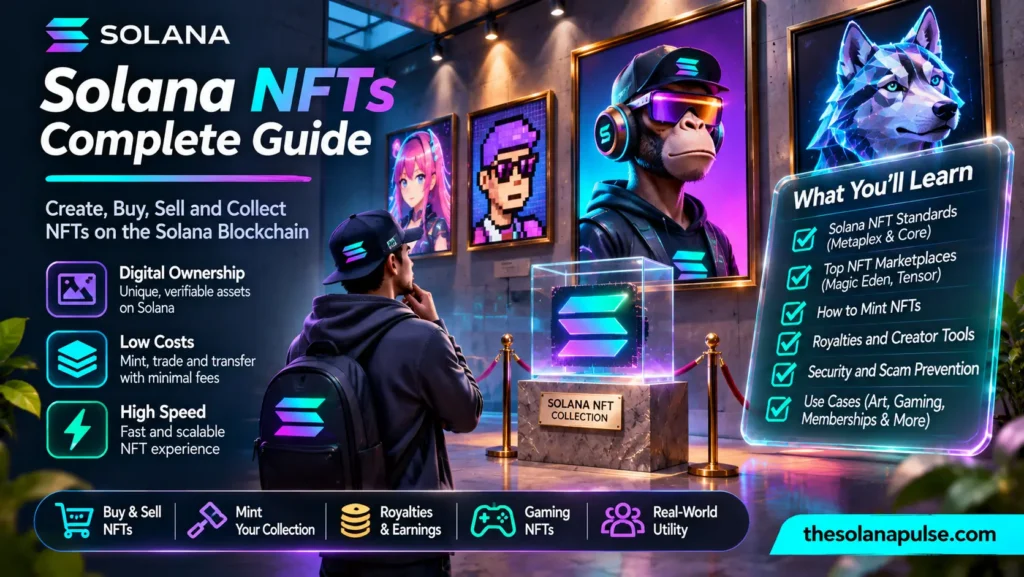
For the standards behind these assets, including Metaplex Core and Bubblegum V2, use our Solana NFTs Hub.
3. Compressed NFTs and Mass-Scale Game Inventory
A game may need millions of items: skins, achievements, crafting materials, characters or event rewards. Creating every object with a full standalone blockchain account can be unnecessarily expensive.
Metaplex Bubblegum V2 addresses this with compressed NFTs. Instead of storing every asset in its own normal account, it represents cNFT data as leaves inside Merkle trees and commits the tree state onchain.
Metaplex’s current June 2026 documentation estimates that a large tree capable of holding about one million cNFTs can reduce the effective creation cost to roughly 0.00001 SOL per cNFT after accounting for the tree’s upfront rent.
Bubblegum V2 also adds features relevant to games, including freeze/thaw support, soulbound assets, permanent delegates and integration with Metaplex Core collections.
There is an important current limitation: Metaplex says V2 adoption across wallets and marketplaces is still in progress. A game can use cNFTs internally before every external marketplace supports them, but developers should verify compatibility before promising universal transfer or trading.
Primary source: Metaplex Bubblegum V2 ↗
4. Dynamic Game Assets and Onchain Metadata
Not every game item is static. A character gains levels. Armor changes. A quest progresses. A weapon can acquire attributes.
Solana’s Token-2022 metadata-extension guide demonstrates NFTs with programmable onchain metadata fields for game state, including a player’s level, XP, weapon, armor and current quest.
This is useful when the state should move with the asset or be readable by other programs. A character could carry a verifiable progression history that another compatible game or tool can inspect.
That does not mean every stat should be permanently public. Competitive games may need hidden information, anti-cheat systems or private server state. The correct architecture depends on what benefits from public verification.
Official source: Dynamic Metadata NFTs for Games ↗
5. Saving Game State on Solana
Solana programs can store player state in program-owned accounts. The official game cookbook shows a simple model where a player’s public key derives a PlayerData account holding values such as energy, health and last-login time.
This is a different concept from an NFT. An NFT represents an asset. A program account can represent arbitrary application state.
Useful onchain state can include:
- Player progression
- Match outcomes
- Quest completion
- Guild membership
- Resource balances
- Crafting state
- Leaderboards
- Ownership-linked permissions
The trade-off is that fully onchain state creates storage, indexing and transaction requirements. Developers should put state onchain when verifiability, interoperability or ownership matters—not because “more blockchain” automatically makes the game better.
6. Tokens, Stablecoins and Open Game Economies
Solana games can use fungible tokens for currencies, rewards, governance or resources. They can also use stablecoins such as USDC where price stability is more important than a game-specific speculative token.
Open economies become especially interesting because compatible assets can interact with external markets. A game token may be tradable through a DEX. An NFT can be sold through a marketplace. A guild can hold assets in a shared treasury.
Star Atlas shows this design clearly. Its current SAGE documentation describes ATLAS as an in-game utility token used for ships, crew and resources, and notes that ATLAS can be traded through Solana DEXs such as Jupiter or Raydium.
This creates liquidity—but also exposes the game to market speculation. A game economy can become distorted if players care more about token price than gameplay.
A blockchain should make the game economy more open or useful, not force every action into an investment. Sustainable games still need sinks, sources, progression, balance and entertainment value even when assets can be traded externally.
Where Solana Gaming Meets DeFi
A composable game economy can use DeFi primitives without rebuilding every financial tool from scratch.
Examples could include:
- Swapping game currencies
- Creating liquidity for fungible game tokens
- Guild treasuries holding stablecoins
- Asset rental or collateral systems
- Marketplaces settling in SOL, USDC or game tokens
But financial composability increases risk. When a game item becomes collateral or a game token becomes highly leveraged, gameplay and financial-market risk become linked.
For the finance layer, use the Solana DeFi Hub.
Current Solana Gaming Examples
Solana’s official gaming page currently highlights Star Atlas, Aurory and Genopets among community games. These projects use blockchain in different ways, so they are better treated as examples of design patterns than as a permanent “best games” ranking.
Star Atlas: hybrid and fully onchain experiences in one ecosystem
Star Atlas currently describes itself as a universe of interconnected web, blockchain and 3D gaming products.
SAGE Labs Starbased is a browser-based 4X strategy game built fully on Solana. Its official support documentation says exploration, mining, crafting and transportation actions are signed and settled onchain. Ships, resources and other items exist as wallet-controlled digital assets.
The Star Atlas Unreal Engine 5 experience is different. It is a high-fidelity 3D game available through Epic Games access, with blockchain-linked assets such as Crew NFTs. This hybrid model demonstrates that rendering and moment-to-moment gameplay do not need to be blockchain transactions for asset ownership to remain onchain.
Primary source: Star Atlas — Where Can I Play? ↗
Gaming Infrastructure Beyond Mainnet Transactions
As games move more state onchain, developers need abstractions that reduce complexity and improve responsiveness.
Honeycomb Protocol
Honeycomb’s current documentation describes a Solana gaming toolkit that provides APIs for players and profiles, character management, resources and crafting, missions and staking. It also uses compression to reduce onchain state costs, with Honeycomb claiming reductions of 1,000x or more for some compressed state types.
The important idea is abstraction: game studios do not necessarily want to write custom Solana programs for every inventory, crafting and quest system.
MagicBlock and low-latency state
MagicBlock builds around Solana-compatible Ephemeral Rollups. Its current documentation shows real-time oracle updates in roughly 50–200 ms intervals depending on the asset, and explicitly lists games as a use case for syncing onchain state with real-world events.
This type of infrastructure is useful when a game needs faster or more specialized execution while still settling or composing with Solana.
Primary source: Honeycomb Protocol Docs ↗
Primary source: MagicBlock Docs ↗
Game Engines and Developer Tooling
Solana’s official game-development documentation supports both web development and conventional game-engine workflows.
The developer cookbook lists integrations and SDK paths for Unity, Unreal and Godot, alongside browser and Rust-based development. It also provides examples for Anchor programs, saving game state, token interactions and NFT integration.
This matters because a studio can add blockchain features without replacing the entire game engine. The 3D client can remain in Unity or Unreal while Solana handles ownership, settlement or specific verifiable state.
Three Solana Gaming Models
| Model | What goes onchain? | Best fit | Main advantage | Main trade-off |
|---|---|---|---|---|
| Asset-enabled game | NFTs, tokens, marketplace settlement | Traditional games adding ownership | Simple blockchain integration | Most gameplay still depends on the game operator |
| Hybrid onchain game | Important state, assets and economy | RPGs, strategy, worlds with open economies | Balance between UX and verifiability | Requires careful sync between server and chain |
| Fully onchain game | Most game rules and persistent state | Strategy, turn-based, autonomous worlds | Maximum composability and transparency | Higher architecture and UX complexity |
What Players Should Check Before Playing a Blockchain Game
Phishing copies of game mint pages and marketplaces can look almost identical to the real site.
Signing a login message and signing an asset transfer are not the same action.
Use a separate gaming wallet if the game is experimental or requires frequent transaction approvals.
A good game item can still fall in market value. Do not assume utility guarantees price.
New cNFT standards may display in a wallet before every marketplace supports trading.
If the game uses an embedded wallet, know whether you or the game provider controls recovery and signing authority.
What Developers Should Decide Before Putting a Game Onchain
- Which state actually needs public verification? Do not put graphics or unnecessary high-frequency data onchain.
- Which assets should players own? Decide whether characters, equipment, achievements or currencies benefit from portability.
- What is the onboarding model? External wallet, embedded wallet, session keys or sponsored transactions all create different UX and security trade-offs.
- Which NFT standard fits the scale? Core may fit high-value assets; Bubblegum V2 can fit mass inventory where ecosystem compatibility is sufficient.
- How does the economy remain sustainable? Define token sinks, sources and gameplay purpose before adding external trading.
- What happens when the game changes? Decide how asset metadata, stats and permissions can be upgraded without breaking ownership expectations.
- What can another developer compose with? Open standards become more valuable when third-party tools can read or use the assets safely.
The Main Risks in Solana Gaming
A blockchain can preserve ownership; it cannot make a bad game economy sustainable
Game quality, retention, economic design and security still determine whether an ecosystem lasts. Tradable tokens can amplify both successful design and poor design.
Wallet and phishing risk
Game players may sign more transactions than ordinary crypto users, increasing the importance of clear transaction previews and limited balances.
Smart-contract risk
Onchain game logic can contain bugs that affect assets, inventory, crafting or marketplaces.
Token-economy risk
Inflationary rewards can destroy a game economy if token issuance outpaces genuine demand or useful sinks.
NFT liquidity risk
An item can have a listed floor price without having a real buyer at that price.
Game dependency
You may permanently own an NFT while the game that gives it utility stops operating. Ownership and usefulness are separate concepts.
Compatibility risk
New asset standards may not immediately work across every wallet, marketplace or game.
Governance and balance risk
Players may own assets, but developers can still change gameplay rules, balance, rewards or access unless those rules are fully encoded and immutable.
TheSolanaPulse Gaming Guide Library
This hub is the parent page. The following confirmed supporting pages already exist:
- Solana NFTs Hub — Core, compressed NFTs, metadata, marketplaces and digital ownership.
- Solana for Beginners 2026 — wallets, SOL, tokens and transaction safety.
- Best Solana Wallets in 2026 — wallet comparison and self-custody.
- Phantom Wallet Guide 2026 — Phantom setup and transaction security.
- Solana DeFi Hub — swaps, liquidity and financial composability relevant to open game economies.
Future gaming-cluster articles can include a Best Solana Games 2026 guide, Star Atlas deep dive, onchain gaming explainer, Solana game-development guide, compressed-NFT gaming guide and individual game reviews. Their URLs should be added here only after the posts actually exist.
Solana Gaming FAQ
What is Solana gaming?
Solana gaming refers to games that use the Solana blockchain for features such as player identity, digital assets, game state, currencies, marketplaces or open onchain economies.
Does every Solana game run fully onchain?
No. Many games use hybrid designs where graphics and real-time gameplay run through traditional game engines while ownership or selected state is stored on Solana.
Why use Solana for games?
Solana offers low-cost transactions, shared state and compatibility with wallets, token standards, marketplaces and DeFi. Those features can support frequent digital-asset interactions and open game economies.
What is a compressed NFT in a game?
A compressed NFT is a unique digital asset represented through Merkle-tree state compression. Bubblegum V2 lets developers create very large asset sets at much lower effective per-item cost than standard NFTs.
Can game characters change while remaining NFTs?
Yes. Game state can be stored in linked program accounts or in programmable metadata depending on the asset design. Solana’s Token-2022 guides show examples such as level, XP, equipment and quest state.
Is Star Atlas playable now?
Yes, in multiple forms. Its official documentation currently describes SAGE as a browser-based fully onchain strategy game and its Unreal Engine 5 experience as a separate evolving 3D game available through Epic Games access.
Do I need SOL to play Solana games?
It depends on the game. Some require SOL for network fees; others sponsor fees or abstract them through game-specific systems. Star Atlas, for example, documents an ATLAS fee-payer option in SAGE.
Can Solana game items be sold outside the game?
If the asset standard and game rules allow transfer, blockchain-owned items can potentially be traded through compatible marketplaces. This does not guarantee liquidity or value.
Are blockchain games safer because items are onchain?
No. Onchain ownership improves verifiability, but players still face wallet, phishing, smart-contract, token-economy and liquidity risks.
Final Take: Solana Gaming Is About Selective Onchain Ownership, Not Putting Every Frame on a Blockchain
The strongest case for Solana gaming is not that every game should become fully onchain. It is that games can choose which parts benefit from open ownership and programmable settlement.
A conventional game can use Solana for a few collectible assets. A strategy game can make persistent state publicly verifiable. A virtual economy can let users trade assets through external markets. A developer can use compressed NFTs for millions of low-cost items while keeping graphics and latency-sensitive logic inside a familiar engine.
The ecosystem is also becoming more specialized. Metaplex provides asset standards, Honeycomb abstracts common game systems, MagicBlock develops low-latency Solana-compatible infrastructure, and conventional engines can connect through Solana SDKs rather than being replaced.
For players, the rule is simple: judge the game first and the token second. For developers, put something onchain because it creates ownership, composability or verifiability—not because blockchain is a marketing label.
Use this Solana Gaming Hub as the map. The NFTs Hub explains the asset layer, the wallet guides cover player security, and the DeFi Hub explains the open financial infrastructure that some game economies use. As we publish dedicated game and infrastructure articles, they should link back here as the central gaming authority page.
Official and Primary Sources
- Solana — Gaming
- Solana — Getting Started With Game Development
- Solana — Using NFTs and Digital Assets in Games
- Solana — Dynamic Metadata NFTs Using Token Extensions
- Metaplex — Core
- Metaplex — Bubblegum V2
- Star Atlas — Where Can I Play?
- Star Atlas — SAGE Labs Starbased
- Honeycomb Protocol Documentation
- MagicBlock Documentation